
What is artist merch? A guide for musicians & creators
TL;DR:
- Merchandise often generates more income for independent artists than streaming.
- Creating branded products builds stronger fan relationships and free promotion.
- Print-on-demand is a low-risk option for testing and launching merch lines.
Streaming pays fractions of a penny per play. For most independent musicians, that reality hits hard once the excitement of releasing music fades. What many artists discover too late is that merch revenue exceeds streaming for a significant number of independent creators. Merchandise is not a side hustle. It is often the primary income engine. This guide explains exactly what artist merch is, how it works in practice, and how you can design, launch, and profit from your own merch line without needing a warehouse, a manager, or a record deal behind you.
Table of Contents
- What is artist merch and why does it matter?
- How does selling artist merch work?
- Print-on-demand vs. bulk printing: which is best?
- Maximising income and avoiding common pitfalls
- Why great artist merch is about more than sales
- Ready to launch your own artist merch?
- Frequently asked questions
Key Takeaways
| Point | Details |
|---|---|
| Merch means more than money | Artist merchandise builds loyalty, spreads your brand, and connects you directly with your fans. |
| Start small and test | Launch with 2-3 items, use print-on-demand, and adjust designs based on fan feedback. |
| Choose production wisely | Print-on-demand offers low risk for beginners, while bulk printing is best for confident, high-volume sales. |
| Profit margins vary | Expect 20-40% margin on shirts via POD and higher on accessories, but plan for higher upfront costs with bulk runs. |
What is artist merch and why does it matter?
Artist merch is any branded product you design and sell to your fans. It is a direct extension of your creative identity, translated into something physical that people can own, wear, and carry into the world. Branded products like t-shirts, hoodies, hats, stickers, and posters are the most common formats, but the category stretches as far as your imagination allows. Tote bags, mugs, keyrings, coasters, and limited-edition prints all fall under the umbrella.
What makes merch so powerful is not just the revenue it generates. It is the relationship it builds. When a fan buys your hoodie, they are making a statement about who they are. They are aligning themselves with your music, your values, and your story. That is something a Spotify stream simply cannot replicate.
Think about it this way: every person wearing your t-shirt at a gig, on the tube, or in a coffee queue is a walking advertisement. They are doing your promotion for free, and they paid you for the privilege. That is a remarkable dynamic that merch boosts income and brand awareness simultaneously.
Here is what artist merch typically includes:
- Clothing: T-shirts, hoodies, long-sleeves, caps, and beanies
- Accessories: Tote bags, keyrings, pins, and patches
- Homewares: Mugs, coasters, and prints
- Collectibles: Signed posters, limited-edition items, and stickers
- Bundles: Merch paired with digital releases or exclusive content
“Your merch is not just a product. It is a piece of your world that fans get to take home. The best artist merchandise tells a story that the music started.”
Fans who buy merch are also your most loyal supporters. They are the ones who share your posts, attend your shows, and recommend your music to friends. Cultivating that group through selling fan favourites that genuinely resonate is one of the smartest moves any independent artist can make.

How does selling artist merch work?
The process of selling artist merch is more straightforward than most musicians expect. You do not need to order hundreds of units upfront or manage a stockroom. Modern tools have made it genuinely accessible for any creator at any stage of their career.
Here is how the process typically unfolds:
- Create your design. Start with artwork that reflects your brand. This could be your logo, album art, a lyric, or an original illustration. If design is not your strength, platforms and freelancers can help.
- Choose your products. Decide which items suit your audience. T-shirts and hoodies are reliable starting points. Accessories like stickers and tote bags are lower cost and often high margin.
- Select a production method. Artists commonly use print-on-demand services to produce and ship goods only after a fan places an order. This removes all upfront financial risk.
- Set up your store. You need somewhere for fans to buy. This could be a standalone online shop or a page integrated into your existing website. Setting up an online merch store is simpler than it sounds, especially with platforms designed specifically for creators.
- Price your products. Factor in production costs, shipping, and your desired margin. Research what similar artists charge. Fans expect to pay a fair price for quality.
- Promote your merch. Share it across social media, mention it at gigs, include it in your email newsletter, and bundle it with new releases to drive initial sales.
- Fulfil orders. With print-on-demand, this happens automatically. With bulk stock, you or a fulfilment partner handles packing and shipping.
Income varies considerably depending on your audience size and how actively you promote. New merch sellers typically earn £0 to £200 monthly, while established artists with engaged fanbases can reach £1,000 to £5,000 or more per month. The key is consistency and iteration. Follow the merch store setup steps methodically, and your store will grow alongside your audience.
Pro Tip: Do not wait until you have thousands of followers to launch merch. Even a small, dedicated fanbase will buy from you if the product feels personal and well made.
Print-on-demand vs. bulk printing: which is best?
Once you understand the basic process, deciding how you will get your merch produced is crucial. There are two main routes: print-on-demand and bulk printing. Each suits different situations, and understanding the trade-offs will save you money and frustration.
| Feature | Print-on-demand | Bulk printing |
|---|---|---|
| Upfront cost | None | Significant investment required |
| Profit margin per item | Lower | Higher |
| Minimum order quantity | None | Usually 25 to 500+ units |
| Quality control | Limited | Full control |
| Speed to market | Fast | Slower (production lead times) |
| Best for | Online sales, testing designs | Live events, established sellers |
| Stock management | Not required | Storage and logistics needed |
Print-on-demand offers low risk and no upfront costs, but comes with lower margins per item and less direct quality control. Bulk printing gives you better profit per unit but requires investment and inventory management. Neither option is universally better. The right choice depends on where you are in your journey.
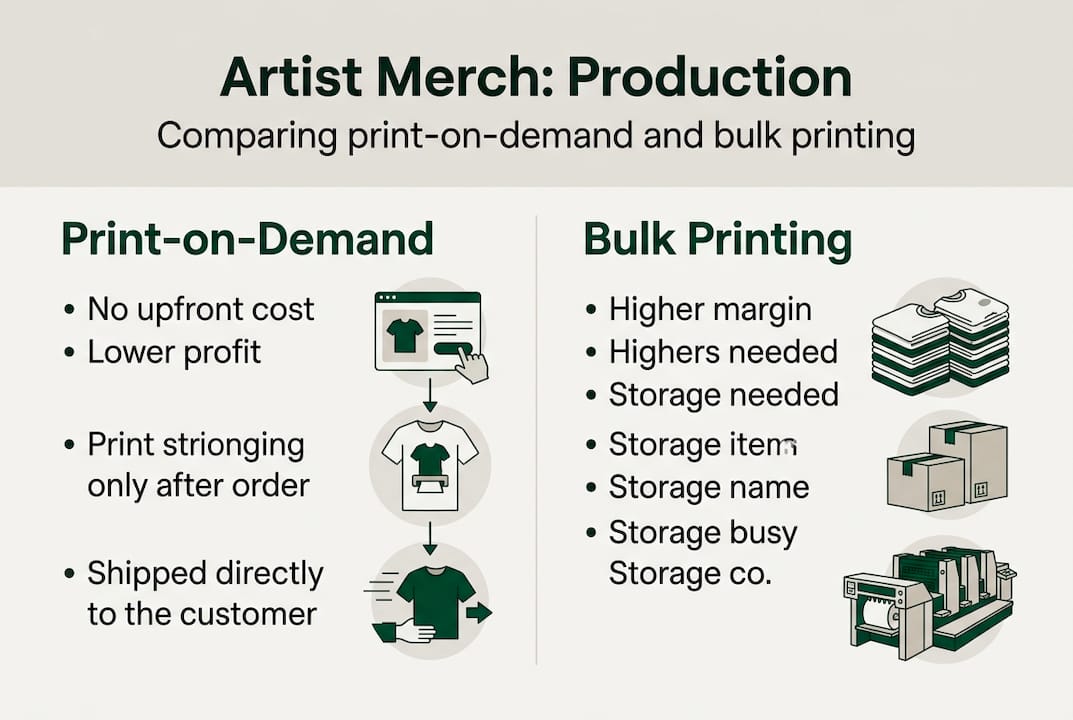
For most independent artists starting out, print-on-demand is the sensible entry point. You can test multiple designs, see what your fans actually want, and refine your range without losing money on unsold stock. Once you identify your bestsellers and have a live event schedule, bulk printing becomes worth exploring for those specific products.
The merch design process itself also influences which method suits you. Intricate, full-colour designs may look better with certain printing techniques that bulk suppliers specialise in, while simpler artwork translates well across most print-on-demand platforms.
Pro Tip: Order a sample of any print-on-demand product before listing it publicly. What looks great on screen does not always translate perfectly to fabric or print. A £15 sample could save you a flood of refund requests.
Maximising income and avoiding common pitfalls
Choosing your production method is just the beginning. Here is how to truly maximise merch success while protecting your profits.
Understanding realistic income benchmarks helps you set smart goals. Merch beginners may earn £0 to £200 per month, while successful artists reach £1,000 to £5,000 monthly. Accessories like stickers and pins often carry higher profit margins than clothing, making them excellent additions to any range.
| Monthly earnings stage | Typical audience size | Key driver |
|---|---|---|
| £0 to £200 | Under 1,000 followers | Learning phase, limited promotion |
| £200 to £1,000 | 1,000 to 10,000 followers | Consistent posting, fan engagement |
| £1,000 to £5,000+ | 10,000+ followers | Strong brand, bundles, live events |
Here are the most effective ways to grow your merch income:
- Start small and focused. Launch with two or three items rather than an overwhelming catalogue. A great T-shirt and a sticker pack is a solid beginning.
- Bundle with releases. Pair new merch drops with single or album releases. Fans are most engaged and most likely to buy at those moments.
- Use social proof. Share photos of fans wearing or using your merch. Real people in real settings convert far better than product mockups.
- Test designs via print-on-demand before committing to bulk orders. Let your audience tell you what they love.
- Explore maximising merch earnings by offering limited-edition runs that create urgency.
Common pitfalls to avoid include over-ordering stock on untested designs, pricing too low and eroding your margins, and neglecting quality checks. Also, do not underestimate packaging. A well-presented parcel adds to the fan experience and encourages repeat purchases. Thoughtful creating merch designs that genuinely connect with your audience is where the real competitive edge lies.
Pro Tip: Accessories like enamel pins and stickers have some of the best margins in the merch world. They are cheap to produce, easy to ship, and fans collect them obsessively.
Why great artist merch is about more than sales
We spend a lot of time talking about margins, platforms, and production methods. All of that matters. But the artists who build truly lasting merch lines are thinking about something deeper.
The most memorable merch becomes part of fans’ everyday lives. It sits on their desk, hangs in their wardrobe, or gets stuck to their laptop. That daily presence is a form of connection that no algorithm can manufacture. When a fan reaches for your mug every morning, they are thinking of you without even realising it.
Purposeful design and genuine engagement build loyalty that outlasts any single release cycle. Artists who treat merch as an afterthought miss this entirely. The ones who innovate, who release limited editions with personal touches, who involve fans in the creative process, cultivate something rarer than revenue. They cultivate brand ambassadorship. Understanding the merch process explained from a creative standpoint, not just a logistical one, is what separates a transactional store from a genuine fan experience.
Merch is not a shop. It is a conversation.
Ready to launch your own artist merch?
If you have been putting off launching your merch because it felt complicated or expensive, this is your sign to start. The Inner Sanctum Group makes it straightforward for independent artists to create and sell quality merchandise without any upfront stock investment.
From a single customisable artist T-shirt to a full range of branded products, you can begin wherever feels right for you. Explore logo T-shirt options or browse the full catalogue of merchandise solutions designed with creators in mind. ISG handles printing, packing, and shipping so you can focus on making music and connecting with your fans.
Frequently asked questions
What are the most popular artist merch items?
Top items include t-shirts, hoodies, stickers, and posters, though accessories like tote bags and enamel pins are also strong sellers with excellent profit margins.
How much does it cost to start selling artist merch?
You can start with no upfront costs at all. Print-on-demand eliminates upfront investment by only charging production costs after a fan completes a purchase.
Can selling merch really provide more income than music streaming?
For many independent artists, yes. Merch often out-earns streaming revenue because royalty rates are so low that even modest merch sales can surpass months of stream counts.
Which is better: print-on-demand or bulk printing?
Print-on-demand suits online and low-risk selling, while bulk printing offers better margins for high-volume situations like live events, though it requires more upfront investment.
Recommended
- What is creator merch management? A 2026 guide for artists – The Inner Sanctum Group
- How merch supports team branding for indie musicians – The Inner Sanctum Group
- How merch supports independent artists’ brand and revenue – The Inner Sanctum Group
- Merchandising for independent musicians: create and sell fan favourite – The Inner Sanctum Group