
Merch store setup guide for independent artists 2026
Independent musicians often struggle to monetise their fanbase beyond streaming, leaving lucrative merch revenue on the table. With profit margins exceeding 30% on many products, merchandise offers a high-return income stream that most artists underutilise. This guide walks you through easy setup, smart product selection, and effective promotion strategies using the latest tools available in 2026.
Table of Contents
- Why Merch Matters: Turning Fans Into Revenue
- Preparing Your Merch Store: Essentials And Platform Choices
- Launching And Promoting Your Merch Store Successfully
- Avoiding Pitfalls And Measuring Success
- Explore Merch Products And Support For Artists
- Frequently Asked Questions
Key takeaways
| Point | Details |
|---|---|
| Treat merch as a business | Merchandising requires dedicated product strategy, not an afterthought to music creation. |
| Start small and focused | Launch with 2-3 products to test fan preferences and minimise upfront risk. |
| Leverage print-on-demand | POD services automate logistics and eliminate inventory costs, offering low-risk entry. |
| Integrate social shopping | Meet fans where they are by enabling direct purchases on Instagram, TikTok, and YouTube. |
| Platform choice impacts profit | Select POD providers based on quality, margins, and branding needs to maximise revenue. |
Why merch matters: turning fans into revenue
Merchandise transforms your audience into walking adverts whilst generating serious income. Every t-shirt or hoodie sold promotes your brand in public spaces, creating impressions that streaming simply cannot match. More importantly, profit margins on physical products dwarf streaming payouts, with many items yielding 30-80% returns compared to fractions of a penny per stream.
Artists who treat merch as an afterthought leave the highest-margin revenue stream underdeveloped. Streaming platforms pay roughly £0.003 per listen, meaning you need thousands of plays to match the profit from a single hoodie sale. Merchandise requires its own sales strategy, production planning, and inventory management to succeed.
Skipping merch entirely risks leaving substantial money on the table. Consider these benefits:
- Physical products create tangible connections between you and fans
- Merch sales provide predictable revenue outside algorithm-dependent platforms
- Quality merchandise reinforces your professional brand image
- Fans actively seek ways to support artists they love beyond streaming
The key shift involves treating your merch business as a dedicated product line, not a side project. This means researching fan preferences, testing designs, monitoring conversion rates, and refining your catalogue based on real data. Without this structured approach, even talented artists struggle to convert enthusiasm into sustainable merch income.
“Your merch store is a second revenue engine that runs 24/7, converting fan loyalty into profit margins that streaming can never match.”
Preparing your merch store: essentials and platform choices
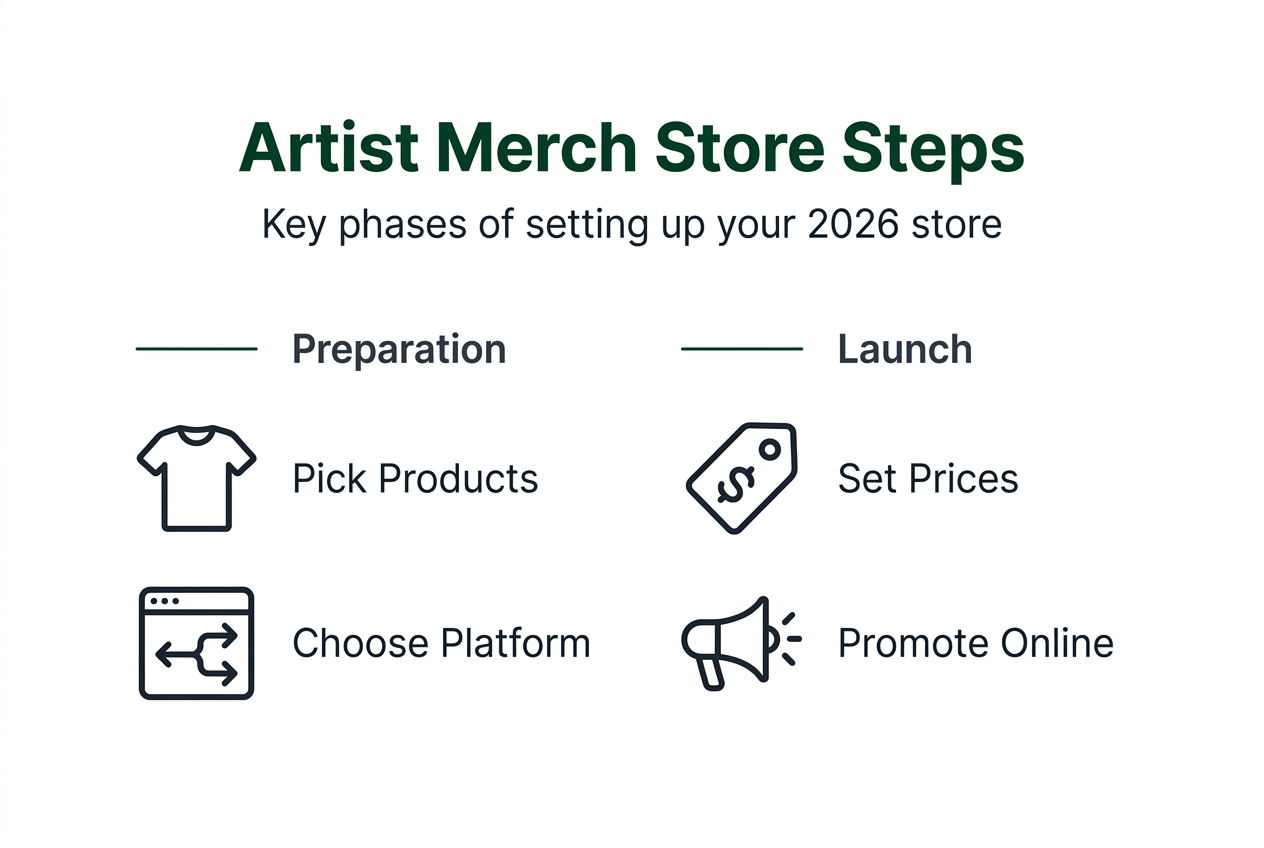
Successful merch launches begin with focused product selection and the right platform infrastructure. Trying to sell everything at once overwhelms both you and your audience, diluting your brand and complicating logistics. Start with two or three items for easy management and data-driven expansion.
Your initial lineup should include:
- A core t-shirt design that represents your brand identity
- A low-cost impulse item like stickers or keyrings (under £5)
- A premium product such as hoodies or limited prints (£30-50 range)
This structure tests different price points whilst keeping inventory manageable. The impulse item converts casual fans, the t-shirt serves as your flagship product, and the premium piece targets dedicated supporters willing to invest more.
Choosing the right print-on-demand service determines your profit margins and brand quality. POD platforms automate fulfilment, eliminating upfront inventory costs and shipping headaches. Here’s how the major options compare:

| Platform | Strengths | Best For | Starting Cost |
|---|---|---|---|
| Printful | Premium quality, white-label branding, mockup generator | Artists prioritising quality and professional presentation | Free plan, pay per order |
| Printify | Lower product costs, multiple suppliers, higher margins | Cost-conscious artists maximising profit per sale | Free or £24/month Premium |
| Teespring | Beginner-friendly, built-in marketplace, simple setup | First-time sellers wanting easy entry | Free, takes commission |
Integrations with Shopify or Etsy streamline order management by connecting your POD service directly to your storefront. When a fan purchases a shirt, the order automatically routes to your POD provider, who prints, packs, and ships without your involvement. This automation frees you to focus on creating and promoting.
Consider free plans initially, then upgrade as sales grow. Big Cartel offers free plans for small catalogues (up to 5 products), whilst Printify Premium costs £24 monthly but unlocks up to 20% higher profit margins through discounted product pricing. Calculate your break-even point: if Premium saves £2 per item and you sell 15 items monthly, the subscription pays for itself.
Pro Tip: Test your initial product lineup for 30 days before expanding. Track which items sell best and gather fan feedback through post-purchase emails to guide your next designs.
Explore customisable t-shirt options that balance quality with affordability, or review The Merch Stand overview for comprehensive setup guidance.
Launching and promoting your merch store successfully
Publishing your store marks the beginning of active promotion, not the end of setup work. Simply creating product pages guarantees nothing; fans need to discover your merch, understand its value, and experience frictionless purchasing. Meeting audiences where they already spend time dramatically increases conversion rates.
Social media platforms integrate shopping features that let fans purchase directly from Instagram, Facebook, YouTube, and TikTok. Enable these features by:
- Linking your e-commerce store to your social profiles through platform business settings
- Tagging products in posts, stories, and videos using built-in shopping tools
- Creating shoppable content that showcases merch in authentic contexts (rehearsals, gigs, everyday wear)
- Enabling one-click checkout to reduce purchase friction
This integration eliminates the barrier of fans needing to visit a separate website. When they see a design they love in your Instagram story, they tap, purchase, and return to scrolling within seconds. Every extra click between discovery and purchase loses potential sales.
Email and SMS marketing automations engage fans at scale without constant manual effort. Set up automated sequences for:
- Welcome emails introducing new subscribers to your merch catalogue
- Post-purchase follow-ups requesting reviews and showcasing related products
- Abandoned cart reminders for fans who added items but didn’t complete checkout
- Drop announcements for new designs or limited releases
Promotional tactics beyond automation include:
- Collaborating with other artists for cross-promotion and bundle deals
- Running giveaways that require entry actions like following, sharing, or tagging friends
- Creating behind-the-scenes content showing design processes or production
- Offering time-limited discounts to create urgency (24-hour flash sales)
- Showcasing fan photos wearing your merch to build social proof
Mobile optimisation cannot be overstated. Most fans browse social media and make impulse purchases on phones, making fast load times and simple checkout essential. Test your store on multiple devices to ensure buttons are easily tappable, images load quickly, and checkout requires minimal form-filling.
Pro Tip: Prioritise mobile-first design and aim for checkout completion in under 60 seconds. Every additional field or slow-loading page increases cart abandonment rates.
Learn more about using The ISG Merch Stand effectively or review the merch pricing guide to set competitive yet profitable prices.
Avoiding pitfalls and measuring success
Common mistakes sabotage even well-designed merch stores, but recognising these patterns helps you avoid costly errors. Many artists launch without validating fan interest, resulting in unsold inventory and wasted marketing effort. Others neglect technical basics like mobile performance, directly impacting revenue.
Typical pitfalls include:
- Ignoring fan data when selecting products, leading to designs nobody wants
- Slow-loading mobile stores that frustrate shoppers and increase bounce rates
- Poor product descriptions that fail to convey quality, sizing, or unique features
- Uncoordinated marketing that sends mixed messages across platforms
- Overcomplicating checkout with unnecessary account creation requirements
Mobile load times over 8 seconds and disconnected tools caused lost merch revenue for a platinum artist, highlighting how technical issues directly impact sales. Every second of delay costs conversions, particularly on mobile devices where users expect instant gratification.
Tracking key metrics reveals what’s working and what needs adjustment. Monitor these indicators monthly:
| Metric | Target Range | What It Reveals |
|---|---|---|
| Conversion Rate | 2-4% | Percentage of visitors who complete purchases |
| Profit Margin | 30-80% | Net profit after production and platform fees |
| Average Order Value | £25-40 | How much fans spend per transaction |
| Cart Abandonment | Below 70% | Checkout friction and purchase hesitation |
| Traffic Sources | Varied | Which platforms drive the most sales |
Use this data to make informed decisions about product expansion and pricing adjustments. If hoodies consistently outperform t-shirts, consider adding more premium items. If Instagram drives 60% of traffic but only 20% of sales, investigate whether your Instagram content adequately showcases products or if technical issues prevent smooth purchasing.
Regularly optimise mobile speed by compressing images, minimising unnecessary scripts, and using fast hosting. Test checkout flows yourself monthly, noting any confusing steps or error messages that might deter buyers. Small improvements compound: reducing checkout from 5 fields to 3 might increase conversions by 15%.
Pro Tip: Centralise fan data by connecting your e-commerce platform, email service, and social media insights. This unified view lets you personalise marketing based on purchase history and browsing behaviour, increasing repeat sales.
Continuously refine your approach based on optimised merch sales strategies and real performance data rather than assumptions.
Explore merch products and support for artists
Ready to launch your merch business with quality products and expert support? The Inner Sanctum Group specialises in helping independent musicians create professional merchandise without upfront inventory costs. We handle design preparation, printing, fulfilment, and shipping, letting you focus on your music whilst earning commission on every sale.
Discover customisable E150 t-shirts that balance quality with affordability, perfect for testing initial fan interest. Explore complete merch bundles like The Public Eye collection to see how cohesive product lines strengthen your brand. Our platform manages the entire process, from product page setup to order tracking, giving you a turnkey merch solution.
Frequently asked questions
What is print-on-demand and how does it work?
Print-on-demand services print and ship merchandise directly after customers purchase, eliminating upfront inventory costs. They integrate with e-commerce platforms, automatically receiving orders and handling fulfilment whilst you focus on promotion and design.
Which print-on-demand platform is best for independent artists?
Printful offers premium quality and white-label branding ideal for artists prioritising professional presentation. Printify provides lower product costs and higher profit margins through multiple supplier options. Teespring suits beginners with its simple setup but offers limited product variety compared to other platforms.
How can I promote my merch store effectively?
Use Instagram, TikTok, and YouTube shopping integrations for direct fan purchases without leaving the platform. Optimise your store and checkout speed, especially on mobile devices where most fans browse. Employ email and SMS automations to engage your audience with new releases, restocks, and exclusive offers.
What are common mistakes to avoid when launching merch?
Don’t launch with too many products without testing demand first, as this spreads resources thin and complicates inventory. Avoid slow-loading stores and complicated checkouts that frustrate mobile shoppers. Never neglect gathering and using fan data to tailor your offerings, as assumptions about preferences often miss the mark.