
How to price merch for bands and boost fan revenue
TL;DR:
- Accurate cost calculation and a 10-15% buffer are essential for profitable merch pricing.
- Using market benchmarks and tiered pricing helps align with fan expectations and maximize revenue.
- Regular testing and adjustment of prices and bundles optimize profits and build fan trust.
Most independent bands pour their hearts into their music but treat merch pricing as an afterthought. They pick a round number, hope for the best, and wonder why profits never materialise. The truth is that without a clear pricing formula, you are either leaving money on the table or quietly driving fans away with prices that feel off. This guide walks you through every stage of band merch pricing, from calculating your true costs to setting market-competitive tiers, so you can build a merch operation that actually supports your music.
Table of Contents
- Calculate your total costs before you price
- Choose the right pricing formula and margin targets
- Find market benchmarks and tier your merch pricing
- Test, adjust, and maximise profits with advanced strategies
- Why most bands undercharge—and what actually works
- Take your merch pricing—and sales—further
- Frequently asked questions
Key Takeaways
| Point | Details |
|---|---|
| Know all your costs | Track every expense—production, fees, shipping—to avoid hidden losses. |
| Set sustainable margins | Aim for at least 50–75% gross margin to ensure profit and long-term viability. |
| Use market benchmarks | Check current merch prices to stay competitive while protecting your brand’s value. |
| Test and adapt | Regularly adjust prices based on real sales data and fan response. |
| Be confident in your value | Don’t undercharge—fair pricing supports your music and builds deeper fan loyalty. |
Calculate your total costs before you price
Having set the scene on why pricing matters, let’s begin with the practical foundation: what are you actually paying to create and sell your merch?
Before you type a single price into your store, you need to know your cost per unit with precision. This is not just the print cost. It is every expense that touches that item before a fan holds it. Understanding merch costs properly is the single biggest step most bands skip, and it is why so many end up surprised at how little they actually earn.
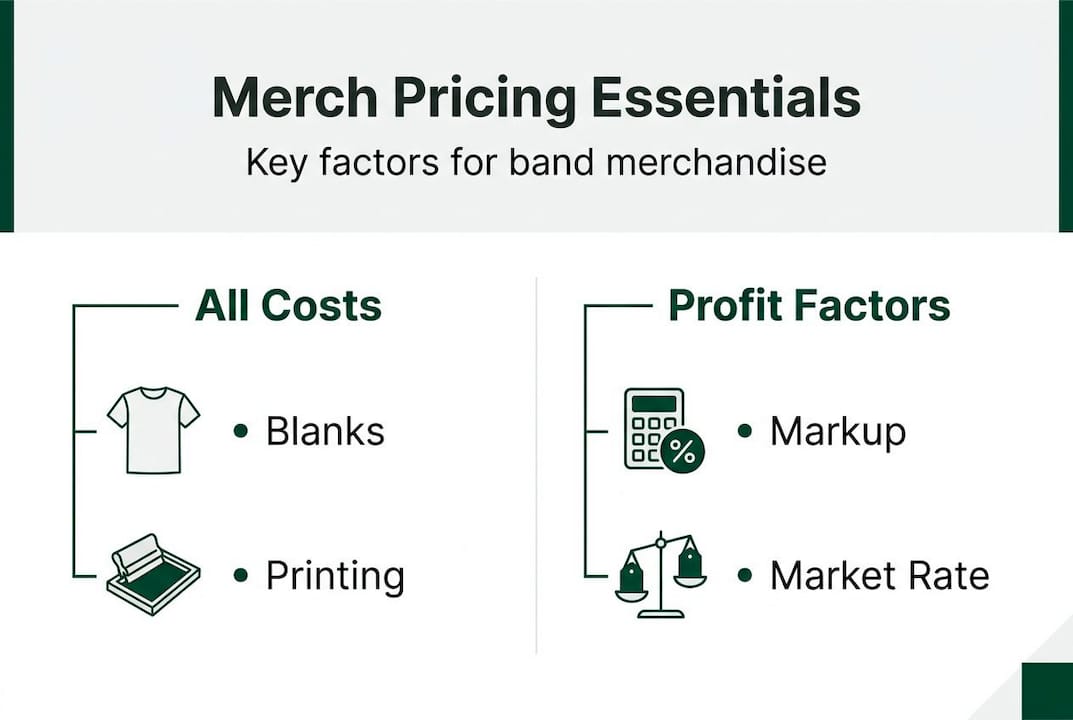
Here is a breakdown of the typical costs you need to account for:
| Cost type | Typical range |
|---|---|
| Garment or product blank | £4 to £12 |
| Print or embroidery | £2 to £6 |
| Shipping to you (bulk) | £0.50 to £2 per unit |
| Packaging (bags, tissue, stickers) | £0.20 to £0.80 |
| Transaction fees | 2.9% + £0.25 per sale |
| Platform fees | 10% (e.g., Bandcamp) |
As you can see, total cost per unit includes production, shipping to you, packaging, transaction fees, and platform fees, and these add up fast. A £6 blank tee can easily become a £10 to £12 unit cost once everything is factored in.
Beyond the obvious, there are costs that bands routinely forget:
- Currency conversion fees if you are selling internationally or buying blanks in dollars
- Promoter or venue cuts at live events, which can reach 20% of your merch takings
- Customs and import duties if you are shipping globally or sourcing from overseas suppliers
- Design and artwork fees if you commissioned the graphic from an external artist
- Returns and reprints for faulty or misprinted items
For a detailed production breakdown of how these figures interact, it helps to map out each item in your range individually before you set any prices.
Pro Tip: Always build a 10 to 15% buffer on top of your calculated cost per unit. Variable fees, surprise customs charges, and small reprints will eat into your margin if you have not planned for them.
Choose the right pricing formula and margin targets
With your costs clear, it is time to look at the next crucial step: turning those numbers into a profitable, market-ready price.
There are two reliable methods for setting your selling price. The first is a simple markup multiplier: multiply your cost per unit by 2 to 3 times. The second is the margin formula: Retail price = Cost divided by (1 minus your desired margin). So if your cost is £14 and you want a 60% margin, your retail price is £35. Both methods are widely used, and the margin formula approach gives you more control over your financial targets.
Here is how those numbers look in practice across common band merch items:
| Item | Cost of goods (COGS) | 2.5x markup | 60% margin price |
|---|---|---|---|
| T-shirt | £10 | £25 | £25 |
| Hoodie | £22 | £55 | £55 |
| Tote bag | £5 | £12.50 | £12.50 |
| Mug | £4 | £10 | £10 |
| Sticker | £0.50 | £1.25 | £1.25 |
Notice that both methods often land in the same place. That is reassuring. It means the maths is consistent.
To calculate your price step by step:
- Add up every cost component for that item (blank, print, packaging, fees)
- Add your 10 to 15% buffer to that total
- Decide on your target margin (minimum 50%, ideally 60 to 75%)
- Apply the formula: Price = Cost divided by (1 minus margin)
- Round to the nearest sensible price point (more on this in section 5)
For pricing essentials that support long-term sustainability, target a minimum 50% gross margin on every item. Bulk orders can yield margins of 50 to 80%, while print-on-demand (POD) typically delivers 25 to 50%. Neither is wrong. They serve different purposes, which we will cover shortly.
Find market benchmarks and tier your merch pricing
Once you have run your numbers, you will want to make sure your prices actually connect with fans, stand out from the crowd, and do not leave money on the table.
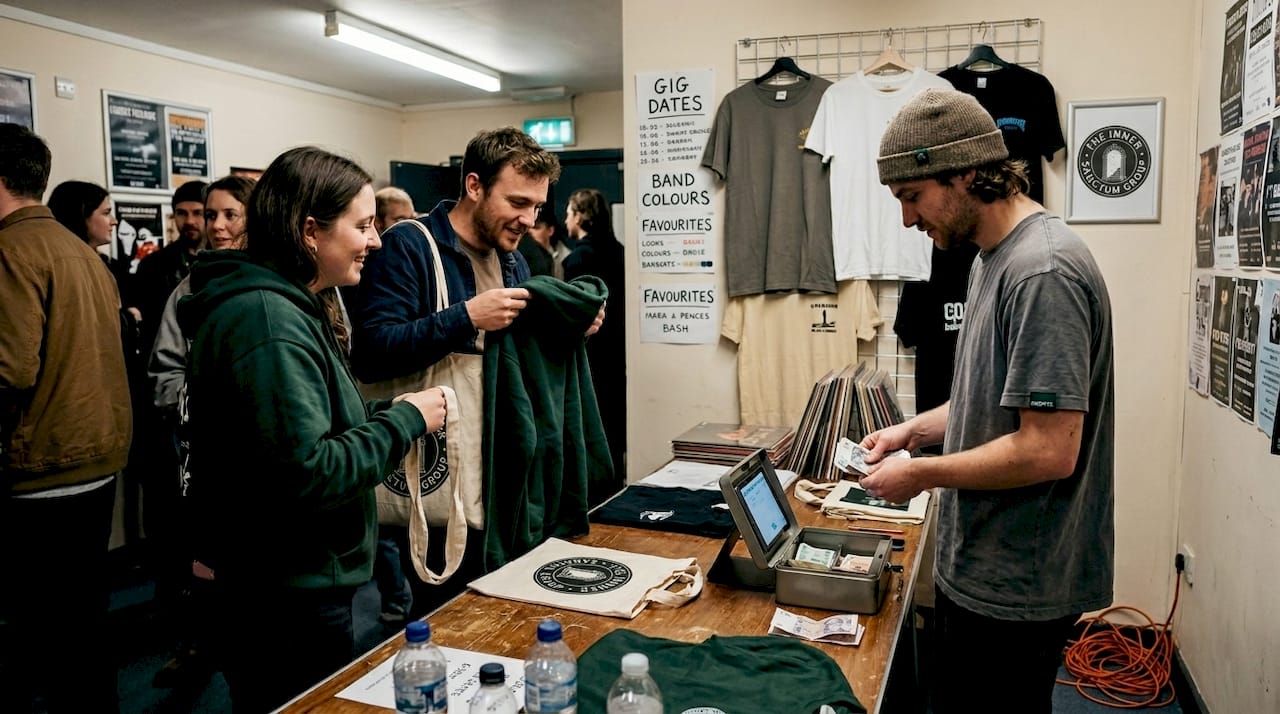
Knowing your costs is essential, but pricing in a vacuum is a mistake. Fans already have a sense of what band merch should cost. If you price too low, they question the quality. Price too high without justification, and they scroll past. Standard pricing benchmarks for 2026 in the US market give a useful reference point:
| Item | Market price range | Typical cost | Margin |
|---|---|---|---|
| T-shirt | $25 to $40 | $7 to $15 | 50 to 75% |
| Hoodie | $45 to $65 | $18 to $28 | 55 to 65% |
| Tote bag | $15 to $25 | $3 to $6 | 70 to 80% |
| Sticker | $3 to $5 | under $0.50 | 600%+ |
| Pin badge | $12 to $18 | $2 to $3 | 80%+ |
| Vinyl record | $28 to $50 | $10 to $15 | 50 to 65% |
Stickers are genuinely extraordinary on margin. They are also a gateway product that gets your name into fans’ lives cheaply. Never underestimate them.
Beyond individual items, smart bands use a three-tier pricing structure to serve every type of fan:
- Entry tier (£4 to £12): Stickers, pin badges, keyrings. Low commitment, high volume, great for new fans.
- Core tier (£20 to £35): T-shirts, hats, tote bags. Your bread and butter, where most revenue comes from.
- Premium tier (£45 and above): Hoodies, bundles, limited editions. For dedicated supporters who want to invest in you.
As the merch business for artists principle goes: “Price at market rates, not cost-plus.” Your cost is your floor. The market sets your ceiling. Work within that range.
Bundles are particularly powerful for driving average order value (AOV). Pairing a tee with a sticker sheet at a slight discount encourages fans to spend more in a single transaction. Explore fan-favourite items that work well in bundles, and consider how merch supports brand and revenue beyond just the immediate sale.
Test, adjust, and maximise profits with advanced strategies
With your price points chosen, it is time to make sure you never stop improving. Here is how you can test, adapt, and use every tool to maximise profit and fan response.
Pricing is not a one-time decision. It is an ongoing process. Follow these steps to build a pricing system that improves over time:
- Launch at your calculated price based on costs and market benchmarks
- Track sell-through rates over 30 to 60 days. If an item sells out fast, your price is likely too low.
- Raise prices incrementally on consistently popular items, by £2 to £5 at a time
- Test bundles against individual items to see which drives higher AOV
- Review after every tour or campaign and adjust based on what you learned
For online merch store options and the right platform setup, your pricing strategy should align with where you are selling.
Pro Tip: Use odd pricing wherever possible. £29 consistently outperforms £30. It feels meaningfully cheaper to the buyer, even though the difference is negligible to you. Anchor your store with a premium item at the top so mid-range prices feel like great value by comparison.
For inventory decisions, the bulk versus POD comparison is straightforward: bulk orders yield 60 to 80% margins but require upfront costs of £400 or more and carry inventory risk. POD delivers 30 to 50% margins with no upfront investment and is ideal for testing new designs. The smartest approach is hybrid. Use POD to validate a design. Once it proves popular, switch to bulk for that item to capture the higher margin.
Do not forget edge cases. Add £2 to £3 for larger sizes where your blank costs are higher. For limited drops or tour exclusives, price significantly above your standard range. Scarcity justifies a premium, and fans expect it.
Why most bands undercharge—and what actually works
After all the technical details, there is an uncomfortable truth worth addressing directly.
The most common pricing mistake we see from independent bands is not a maths error. It is a confidence problem. Bands worry that charging a fair market price will feel like they are exploiting their fans. So they price low, hoping it will drive volume. It rarely does. It mostly signals that the product is not worth much, and it makes the whole operation financially fragile.
The problem gets worse when pricing is inconsistent. Charging £20 for a tee at a gig and £18 online creates confusion. Fans who bought at the gig feel overcharged. Pricing consistently across live shows and online is not just good business practice. It is a trust signal.
Here is the reframe that actually works: a higher price, set at market rate, tells fans that your music and your brand are worth investing in. It funds better quality products, better designs, and ultimately a better experience. Your merch store and brand value are intertwined. Pricing strategically is not greed. It is respect for your art and for the fans who want to support it.
Take your merch pricing—and sales—further
Ready to raise your profits? Here is how you can take the next step on your merchandising journey.
The Inner Sanctum Group exists to make this entire process straightforward for independent bands. You design it, we handle the rest: printing, packing, shipping, and store management, all without you needing to buy stock upfront.

If you want to put the strategies in this guide into action, explore our band e-commerce strategies resource hub for deeper guidance on building a profitable merch operation. Or get in touch with our team directly to talk through your specific range, pricing structure, and goals. We work with bands at every stage, from first drop to full catalogue.
Frequently asked questions
What’s the easiest formula for pricing band merch?
Use a 2 to 3x markup on your total cost per item, or calculate: Price = Cost divided by (1 minus your desired margin). Both methods give you a reliable starting point.
Is it better to use bulk or print-on-demand for band merch?
Bulk orders yield higher margins of 60 to 80% but require upfront investment and carry stock risk. POD offers 30 to 50% margins with no upfront costs, making it ideal for testing new designs before committing.
How should I adjust prices for larger sizes or special editions?
Add £2 to £3 for larger sizes where your blank costs are higher. For limited drops and tour exclusives, price significantly above your standard range to reflect scarcity and demand.
Should band merch cost the same online and at gigs?
Yes. Consistent pricing across gigs and online avoids fan confusion and builds trust. Live shows may convert better, but your prices should not vary between channels.
How often should I review my merch prices?
Review after every tour or campaign, and any time your costs change or demand signals a sell-out. Consistent sell-outs are a clear sign your price is too low.
Recommended
- Merchandising for independent musicians: create and sell fan favourite – The Inner Sanctum Group
- Maximise your band’s merch earnings with e-commerce – The Inner Sanctum Group
- Inspiring fan engagement merch ideas for indie musicians – The Inner Sanctum Group
- How merch supports team branding for indie musicians – The Inner Sanctum Group