
Personalised merch marketing guide for independent creators
TL;DR:
- Personalised merch marketing deepens audience connections and generates sustainable income.
- Creators should start with print-on-demand to test designs and transition successful ones to bulk orders for higher margins.
- Consistent promotion across social media, email, and live events is essential for merch success.
Most independent creators assume that selling merchandise means ordering hundreds of units upfront, renting storage space, and hoping fans actually buy. That assumption keeps talented musicians, podcasters, and artists from ever launching a single product. The reality is far more accessible. Print-on-demand (POD) platforms and hybrid models have completely changed the game, letting you sell branded products to your audience with zero stock commitment and minimal financial risk. This guide breaks down exactly how personalised merch marketing works, which model suits your situation, and how to build a merch strategy that actually earns money rather than gathering dust in a spare room.
Table of Contents
- What personalised merch marketing actually means
- Print-on-demand, bulk, or hybrid? Comparing merch models
- Standing out: Brand, niche, and creative strategies
- From idea to income: Marketing, fulfilment, and real creator tips
- The reality most guides miss about personalised merch
- Level up your merch marketing with expert help
- Frequently asked questions
Key Takeaways
| Point | Details |
|---|---|
| Personalisation builds loyalty | Tailored merchandise deepens fan engagement and supports creator branding. |
| Test with print-on-demand | Start with POD to avoid upfront costs and gauge what sells before scaling up. |
| Niche focus drives success | Merch lines thrive when creators target a clear audience and offer quality, unique designs. |
| Quality and reviews matter | Always order and review samples to ensure high standards in print, material, and fulfilment. |
What personalised merch marketing actually means
Personalised merch marketing is not simply slapping your logo on a T-shirt and hoping for the best. It is the deliberate use of customised physical products to deepen your connection with your audience, reinforce your creative identity, and generate a sustainable income stream alongside your main work.
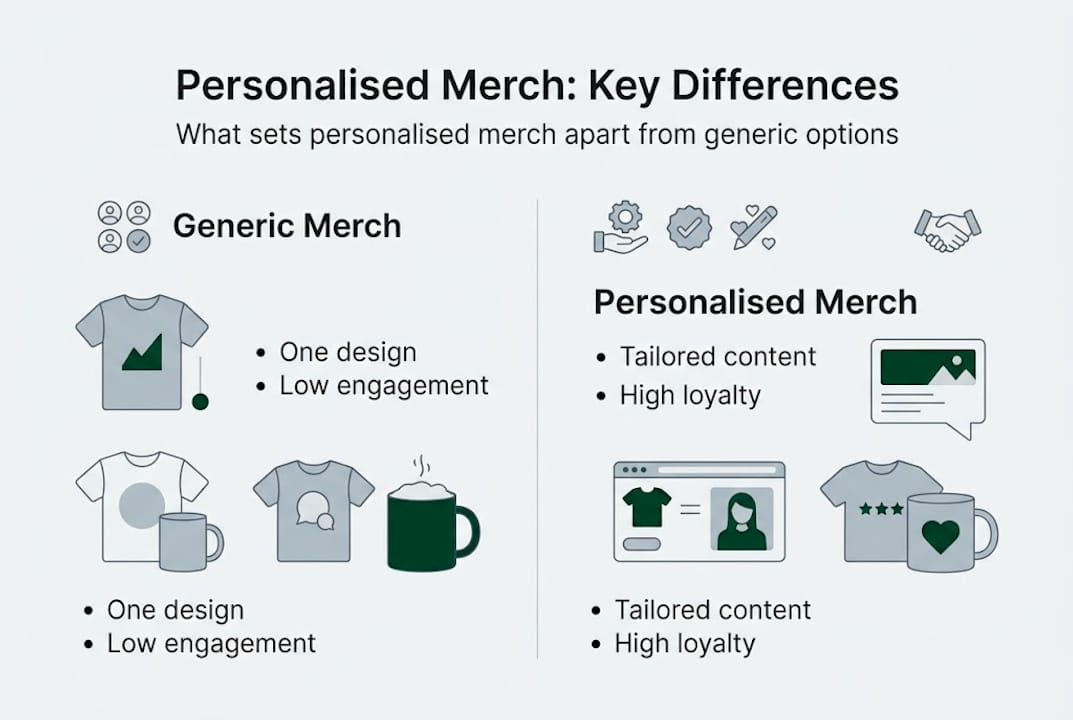
The key difference between generic merchandise and personalised merch is intention. Generic merch is transactional. Personalised merch is relational. When a fan buys a mug featuring an inside joke from your podcast, or a tote bag printed with artwork from your latest album, they are not just buying a product. They are buying a piece of your story.
For independent creators, this matters enormously. You are not competing with major labels or global brands on volume. You are competing on connection, and that is a fight you can win.
Here is what personalised merch marketing typically covers for creators:
- Custom apparel: T-shirts, hoodies, and caps featuring original artwork, lyrics, or slogans
- Everyday items: Mugs, coasters, and tote bags that fans use daily, keeping your brand visible
- Limited edition prints: Artwork or photography that appeals to collectors and superfans
- Event-specific products: Designs tied to a tour date, album launch, or podcast milestone
- Gift-ready items: Keyrings, stickers, and small accessories that make affordable, shareable gifts
Musicians use personalised merch at live shows to create tangible memories. Podcasters send exclusive items to Patreon supporters. Visual artists sell prints that double as home décor. The personal brand merch ideas available to creators today are genuinely broad.
“Personalised merchandise is ideal for creators looking to monetise their audience through events and gifts, turning casual listeners into loyal supporters.”
The real power of personalised merch as a marketing tool is that it works across multiple channels simultaneously. A well-designed product photograph drives Instagram engagement. An exclusive item for newsletter subscribers rewards loyalty. A limited run sold only at live events creates urgency and FOMO (fear of missing out). Done well, your merch does not just earn money. It markets you.
Print-on-demand, bulk, or hybrid? Comparing merch models
Once you understand what personalised merch marketing involves, the next decision is how you actually produce and fulfil orders. There are three main models, and each carries different trade-offs.
Print-on-demand (POD) means a product is only printed when a customer places an order. You upload a design, set a price, and the platform handles printing, packing, and shipping. There is no upfront cost and no inventory risk. The downside is that POD margins sit at 30 to 40%, compared to 70 to 80% for bulk orders. You earn less per sale, but you risk nothing.

Bulk ordering means you pay upfront for a large quantity of printed products, store them yourself, and fulfil orders manually or through a third-party warehouse. Margins are significantly better, but you carry inventory risk. If a design does not sell, you are left with unsold stock.
Hybrid combines both. You test designs through POD, identify bestsellers, then order those specific designs in bulk to improve margins.
| Model | Upfront cost | Margin | Inventory risk | Shipping time | Best for |
|---|---|---|---|---|---|
| Print-on-demand | None | 30 to 40% | None | 5 to 12 days | Testing and starting out |
| Bulk ordering | High | 70 to 80% | High | 1 to 3 days | Proven bestsellers |
| Hybrid | Medium | Variable | Low to medium | Mixed | Scaling creators |
When choosing a model, keep this in mind:
- Start with POD to test which designs your audience actually wants
- Track your bestsellers over three to six months
- Transition those specific designs to bulk ordering for better margins
- Keep POD running for new or seasonal designs you have not yet validated
Pro Tip: Order a sample of every new design before it goes live in your store. What looks great on screen can print differently on fabric or card. A five-minute quality check saves you from disappointing your fans.
One sobering reality: only 24% of POD stores survive past three years. The stores that do survive are not the ones with the most products. They are the ones that create your own custom merch with a clear niche and consistent quality.
Standing out: Brand, niche, and creative strategies
With models compared, the next challenge is actually getting noticed. The POD market is saturated, and generic designs rarely cut through. The success in POD requires a clear niche and a recognisable brand, not a catalogue of random products.
This is where independent creators have a genuine advantage over faceless POD shops. You already have a story, a voice, and an audience that cares about you. The goal is to channel that into your merch.
Here are practical ways to differentiate your merch from the crowd:
- Tell a specific story: A design tied to a song, episode, or personal moment resonates far more than a generic slogan
- Run limited editions: Scarcity drives action. A design available for two weeks only will outsell the same design sold permanently
- Involve your fans: Ask your community to vote on the next design, colour, or product type. They feel ownership, and they buy what they helped create
- Tie merch to events: A design exclusive to your album launch or live tour creates a collector’s item with real emotional value
- Collaborate with other creators: A joint design with a fellow musician or artist introduces you to their audience and vice versa
- Use seasonal hooks: A Christmas-themed design or a summer colourway gives fans a reason to buy now rather than later
The design process for indie merch matters as much as the product itself. A thoughtful, original design on a basic T-shirt will outsell a mediocre design on a premium hoodie every time.
It is also worth thinking carefully about product focus. Creators who try to sell everything often sell nothing well. Pick two or three core products, make them excellent, and build your reputation around those before expanding. If you are launching custom merchandise for the first time, restraint is a strategy.
From idea to income: Marketing, fulfilment, and real creator tips
Knowing what to sell and how to produce it is only half the job. Getting your merch in front of the right people and managing the process smoothly is where most creators struggle. Here is a practical step-by-step framework.
- Create your design: Work with a designer or use tools like Canva. Ensure files meet print specifications (typically 300 DPI minimum)
- Set up your store: Choose a platform that handles fulfilment, or work with a service like The Inner Sanctum Group that manages the entire process for you
- Order samples: Review print quality, colour accuracy, and packaging before launching publicly
- Promote across channels: Use the platforms where your audience already spends time
- Gather feedback: Ask buyers what they think. A simple post-purchase question can reveal what to improve or expand
- Iterate: Retire underperforming designs, double down on bestsellers, and introduce new ideas based on fan input
Different marketing channels serve different purposes for merch promotion:
| Channel | Strength | Best use |
|---|---|---|
| Instagram and TikTok | Visual discovery | Showcasing designs and lifestyle shots |
| Email newsletter | Loyalty and trust | Exclusive drops and early access offers |
| Live shows | Instant feedback and impulse buys | Event-specific or limited designs |
| YouTube | Storytelling | Behind-the-scenes design process content |
| Fan communities | Word of mouth | Crowd-voted designs and fan collaborations |
Creators who promote via social, email, and live shows consistently outperform those who rely on a single channel. Diversify your promotion early.
Pro Tip: Build your merch launch around a moment your audience already cares about. A new single, a podcast anniversary, or a personal milestone gives people a reason to buy today rather than bookmark and forget.
Fulfilment timelines also matter. Standard turnaround times of 5 to 12 days are typical for POD, so set clear expectations with your buyers. Understanding how the merch process works end-to-end helps you communicate honestly with fans and avoid complaints. If you are setting up an online merch store for the first time, prioritise platforms that handle fulfilment automatically so you can focus on creating.
The reality most guides miss about personalised merch
Most merch guides focus on the exciting part: designing products, launching a store, watching orders roll in. What they rarely mention is the reality that follows.
Margins in POD are genuinely thin. After platform fees, production costs, and the occasional refund, your per-sale earnings can feel underwhelming at first. The creators who build meaningful income from merch are not the ones who went viral once. They are the ones who stayed consistent for 12 to 18 months, refined their designs, and treated merch as a brand-building exercise rather than a quick revenue grab.
Merch is not passive income. It requires regular attention, fresh ideas, and ongoing promotion. The good news is that the creators who commit to it often find that merch strengthens their entire brand, not just their bank balance. Fans who own your products become advocates. They wear your name, share photos, and bring new people into your world.
Think about increasing merch earnings online as a long-term investment in your creative identity, not a shortcut to financial freedom. The creators who approach it that way are the ones still selling a year from now.
Level up your merch marketing with expert help
Building a personalised merch strategy takes time, creativity, and the right support behind the scenes. If you are ready to move from idea to action, The Inner Sanctum Group handles the entire merch process for independent creators, from design preparation and printing through to packaging, fulfilment, and store management.
You focus on your music, your podcast, or your art. We handle everything else. Whether you are exploring brand-boosting merch ideas or ready to launch your first product, our platform is built to help creators like you sell without the stress of stock, shipping, or setup. Take the next step today and turn your creative identity into something your fans can hold.
Frequently asked questions
Is personalised merch profitable for small creators?
Personalised merch can be profitable with the right niche and quality focus, though POD margins of 30 to 40% mean you need consistent volume to see meaningful returns. Scaling to bulk ordering for proven designs improves profitability significantly.
What merch products can I personalise and sell?
Popular options include T-shirts, mugs, tote bags, hoodies, prints, coasters, and keyrings. Anything that can carry your artwork, lyrics, or branding and monetise your audience through gifts or events works well.
Are there risks to using print-on-demand?
The main risks are lower profit margins, occasional quality inconsistency between print runs, and shipping times of 5 to 12 days which are longer than bulk-fulfilled orders. Ordering samples before launch reduces most quality risks.
How can I market my personalised merch successfully?
Promote across social media, email newsletters, and live shows, and involve fans in the design process to build excitement before launch. Creators who use multiple promotional channels consistently outperform those relying on one platform.
Should I start with POD or bulk orders?
Start with print-on-demand to test designs with real buyers before committing to bulk stock. POD is the lower-risk entry point for new creators, and transitioning bestsellers to bulk later is a proven way to improve margins without guesswork.
Recommended
- The merch process explained for independent creators 2026 – The Inner Sanctum Group
- Merchandise creation guide: launch custom merch in 2026 – The Inner Sanctum Group
- Merchandising for independent musicians: create and sell fan favourite – The Inner Sanctum Group
- How to create merch designs for independent artists – The Inner Sanctum Group