
Merchandise creation guide: launch custom merch in 2026
TL;DR:
- Print-on-demand allows creators to launch merchandise without upfront costs or inventory risks.
- Success depends on niche clarity, high-quality designs, and listing volume rather than platform choice.
- Active marketing, persistent effort, and volume are key to building sustainable merchandise income.
Custom merchandise is one of the most exciting revenue streams available to independent creators, yet so many musicians, designers, and small business owners never act on it. The fear is always the same: stock costs, storage headaches, and the risk of boxes of unsold hoodies gathering dust. Print-on-demand (POD) has changed all of that. You can now design, list, and sell merchandise without spending a penny upfront, without touching a single product, and without needing a warehouse. This guide walks you through every stage, from picking your niche to scaling your profits, so you can launch with confidence.
Table of Contents
- Choosing your niche and merchandise for success
- Design essentials: creating artwork that sells
- Integrating platforms and setting up your merch store
- Profit margins, marketing, and scaling your merch business
- The real lesson: niche focus, QC, and volume matter most
- Ready to launch? Customisable merch solutions with ISG
- Frequently asked questions
Key Takeaways
| Point | Details |
|---|---|
| Zero upfront risk | Print-on-demand enables creators to launch merchandise lines without investing in inventory or setup costs. |
| Niche and volume drive profits | Success depends on choosing the right niche, developing 100+ designs, and consistent marketing efforts. |
| Quality control is critical | Ordering samples and preparing artwork to high standards prevents costly mistakes and ensures excellent results. |
| Hybrid business boosts margins | Combining POD with digital products increases income and resilience for creators and musicians. |
Choosing your niche and merchandise for success
The foundation of any successful merchandise business is knowing exactly who you are selling to and what they want to wear, carry, or display. Niche selection is not about limiting yourself; it is about becoming the obvious choice for a specific audience. A band with a loyal following, a graphic designer with a distinctive visual style, or a small business with a strong local identity all have natural merchandise audiences waiting to be served.
Popular product categories for creators include t-shirts, hoodies, mugs, tote bags, posters, and stickers. Each serves a different price point and customer motivation. T-shirts and hoodies carry strong emotional value for music fans. Mugs and coasters work brilliantly for niche communities and gifting occasions. Stickers and keyrings act as low-cost entry points that drive impulse purchases.
Features that make merchandise sell consistently:
- Unique artwork that cannot be found anywhere else
- A clear message that resonates with a specific community
- Local or cultural appeal that creates belonging
- Consistent visual identity across your product range
- Limited or seasonal drops that create urgency
When choosing products, align them with your audience’s lifestyle. A fitness creator’s fans want activewear and water bottles. A jazz musician’s audience might favour quality tote bags and art prints. Understanding this prevents wasted effort and keeps your store coherent.
| Product type | Typical profit margin | Customer appeal |
|---|---|---|
| T-shirts | 25-40% | Very high, universal |
| Hoodies | 20-35% | High, seasonal |
| Mugs | 30-45% | Medium, gifting |
| Tote bags | 25-40% | High, eco-conscious |
| Stickers | 40-60% | High, impulse buy |
| Posters | 35-55% | Medium, collectors |
One of the most overlooked strategies is volume. Stores with 100 or more listings consistently outperform those with fewer products, simply because they appear more frequently in search results. Zero upfront investment and global market access make it practical to list broadly without financial risk. For a solid starting point, the merchandise launching guide covers how to structure your first product range, and brand-building merch ideas can spark your creative direction. If you want to understand merch design basics before committing to a product line, that is always time well spent.
Design essentials: creating artwork that sells
Once you have selected your products and niche, the next step is creating compelling designs that print perfectly and sell well. Great merchandise design is not just about aesthetics; it is about artwork that survives the journey from screen to fabric or ceramic without losing its impact.
The technical requirements matter enormously. Designs must be high-resolution, with a minimum of 300 DPI, vector formats preferred, and prepared for colour accuracy across different substrates. Ignoring these requirements leads to the three most common print failures: pixelation, colour shift, and cut-off text.
Here is a step-by-step artwork preparation process:
- Choose your design software. Adobe Illustrator, Affinity Designer, or Canva Pro all work well for merchandise artwork.
- Set your canvas size. Use the print provider’s template dimensions, typically at least 4500 x 5400 pixels for a full front t-shirt print.
- Work in CMYK colour mode. RGB looks vivid on screen but can shift significantly when printed. CMYK gives you a more accurate preview.
- Export at 300 DPI minimum. PNG with a transparent background is the most widely accepted format.
- Check your bleed and safe zones. Keep text and key design elements at least 5mm inside the print boundary.
- Upload to your POD platform and review the mockup carefully. Zoom in on edges and text before publishing.
- Order a physical sample. This is non-negotiable before a full launch.
Pro Tip: Test your design scaled down to a small product like a keyring or sticker. If it still reads clearly at that size, it will work across your entire range. Cluttered designs with too many elements almost always fail at small scales.
For creators working in the fitness or activewear space, the fitness merch design guide](https://theinnersanctumgroup.co.uk/blogs/the-merch-stand/fitness merch design guide 2026 create custom gear) offers specific guidance on performance fabric printing. The broader [design workflow guide is also worth bookmarking for reference throughout your creative process.
Integrating platforms and setting up your merch store
With your designs ready, it is time to connect your artwork to print-on-demand platforms and launch your online shop. Platform choice affects your product range, base costs, print quality, and fulfilment speed, so it deserves careful thought.

Printful, Printify, and Prodigi each offer different strengths in quality, price, and product range. Here is a quick comparison:
| Platform | Product range | Base cost | Quality level | Best for |
|---|---|---|---|---|
| Printful | Wide | Higher | Premium | Brands, quality-first |
| Printify | Very wide | Lower | Variable | Volume sellers |
| Prodigi | Wide | Mid-range | Consistent | Art prints, creators |
For musicians specifically, platforms like Fourthwall and MerchYeah are built around band stores and offer features like fan memberships and pre-order tools that general POD platforms do not.
Integration steps for launching your store:
- Connect your chosen POD platform to Shopify, Etsy, or Fourthwall via their native integrations
- Upload your approved designs and select product variants (sizes, colours)
- Create high-quality mockup images using the platform’s mockup generator
- Write product descriptions that speak to your audience’s identity, not just the product specs
- Set your retail prices based on base cost plus your desired margin
- Publish test listings and place a test order to verify the full customer journey
“No minimum orders and global fulfilment mean creators can list products for audiences worldwide without holding a single unit of stock. The barrier to entry has never been lower.”
For a thorough walkthrough of the process, the [online merch store guide](https://theinnersanctumgroup.co.uk/blogs/the-merch-stand/what is online merch store guide artists 2026) covers platform selection in detail, and the [store setup guide](https://theinnersanctumgroup.co.uk/blogs/the-merch-stand/merch store setup guide independent artists 2026) walks through configuration step by step. For a direct Printify vs Printful comparison, that resource breaks down the differences clearly.
Profit margins, marketing, and scaling your merch business
Your store is live. Now it is vital to understand how pricing, marketing, and scaling affect your profitability. Many creators launch with excitement, then lose momentum when sales do not materialise immediately. The difference between those who succeed and those who quit is nearly always strategy, not luck.
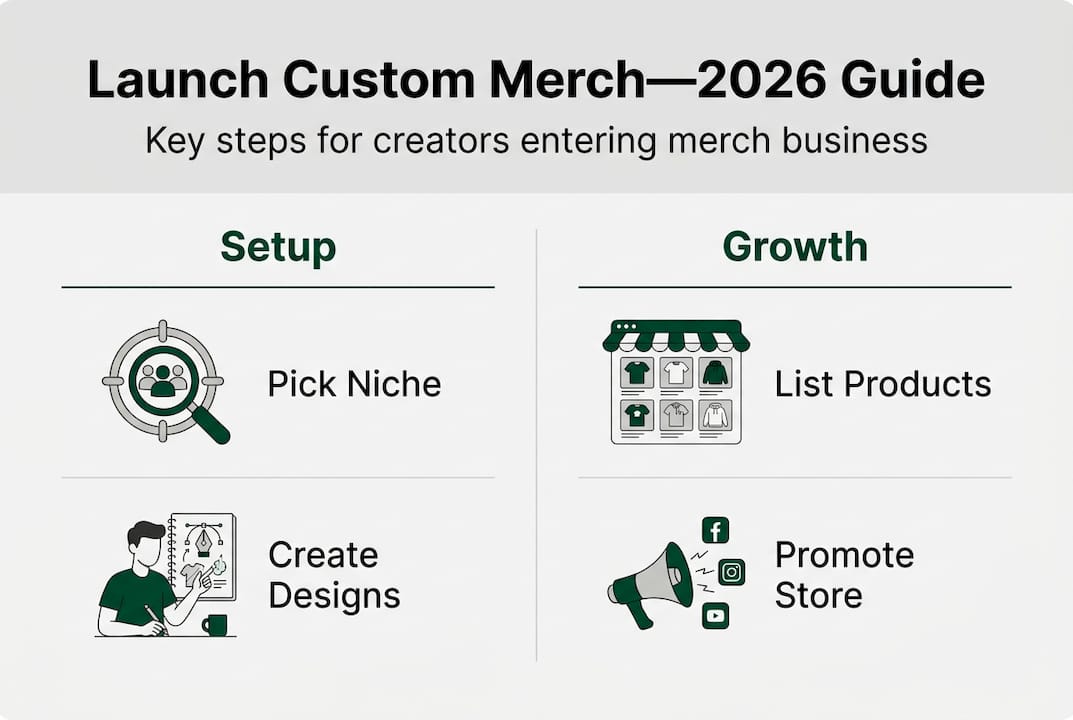
Typical profit margins sit at 20 to 40% gross and 15 to 30% net after platform fees, transaction costs, and any advertising spend. To reach £1,000 monthly profit, you typically need around 156 sales per month, which requires consistent marketing effort and a well-stocked store.
Sales benchmarks to guide your growth:
- Months 1 to 3: Focus on listing volume and organic traffic. Aim for 20 to 30 products live.
- Months 3 to 6: Begin active social media promotion and email list building. Target 5 to 15 sales per month.
- Months 6 to 12: Introduce paid advertising on Meta or TikTok. Aim for 50 to 100 monthly sales.
- Year two onward: Scale listings to 100 or more, diversify products, and explore bundle offers.
Marketing channels that work well for merchandise creators include Instagram and TikTok for visual product content, email newsletters for direct fan engagement, and Pinterest for evergreen product discovery. Customer acquisition costs (CAC) are rising across paid channels, so organic content and community-building remain the most cost-effective long-term strategies.
Pro Tip: Pair your POD merchandise with digital products such as sample packs, design templates, or exclusive downloads. Digital products have near-zero cost of goods, which significantly improves your overall margin and gives customers a reason to return.
For a deeper look at revenue optimisation, [e-commerce merch profits](https://theinnersanctumgroup.co.uk/blogs/the-merch-stand/maximise-band merch earnings ecommerce essentials) covers pricing strategy in practical detail. External POD profit insights are also worth reviewing before you set your final pricing structure.
The real lesson: niche focus, QC, and volume matter most
Here is what most guides will not tell you: the platform you choose matters far less than most creators think. Hours spent debating Printify versus Printful are hours not spent creating listings, building an audience, or ordering samples. The real variables that determine success are niche clarity, quality control, and listing volume.
Most creators fail due to market saturation and insufficient listing volume. Stores with fewer than 20 products and no consistent marketing rarely gain traction, regardless of how good the designs are. The creators who build sustainable merchandise income treat it like a business: they test products rigorously, maintain 100 or more listings, and market relentlessly.
The uncomfortable truth is that merchandise is not passive income in the early stages. It requires active effort, iteration, and patience. Creators who treat their first ten listings as a finished business almost always give up within three months.
Our experience working with independent creators through creator merch strategies confirms this pattern repeatedly. The ones who succeed commit to the process, not just the launch.
Ready to launch? Customisable merch solutions with ISG
If you have followed this guide and you are ready to move from planning to action, The Inner Sanctum Group makes the next step straightforward. ISG handles design preparation, printing, fulfilment, and store management so you can focus entirely on your creative work.
There are no upfront costs, no minimum orders, and no stock to manage. Browse the customisable Creator 2.0 T-shirt or the Output Logo T-shirt to see the quality and customisation options available. Whether you are a musician, designer, or small business owner, the ISG platform gives you everything you need to launch a professional merchandise range without the traditional barriers.
Frequently asked questions
How much can independent creators earn from merchandise?
Net profit for beginners is typically £0 to £500 per month. Scaling to 100 or more listings with active marketing can result in £1k to £5k monthly, based on typical POD gross margins of 20 to 40%.
What are the main pitfalls in merchandise creation for beginners?
The most common mistakes are low-resolution designs, colour mismatches, and launching with too few products. Pixelation and colour shifts almost always result from poor artwork preparation rather than platform limitations.
Do I need inventory or upfront investment for POD merchandise?
No. Print-on-demand platforms only print and ship after a customer places an order, meaning you never hold stock or pay for products before they sell.
What types of merchandise work best for musicians and artists?
T-shirts, posters, and accessories are consistent top sellers for creators. Band-specific platforms like Fourthwall and MerchYeah include store features for musicians that general POD platforms do not offer.
Recommended
- Custom merchandise explained: a creator’s guide to launching merch – The Inner Sanctum Group
- Master the design process for indie artist merch in 2026 – The Inner Sanctum Group
- Boost your personal brand with creative merch ideas in 2026 – The Inner Sanctum Group
- Fitness merch design guide 2026: create custom gear – The Inner Sanctum Group