
Custom merchandise explained: a creator's guide to launching merch
Selling custom merchandise used to mean ordering 500 t-shirts, renting storage space, and hoping your fans would actually buy them. That model locked out most independent artists and musicians before they even started. Today, that barrier is gone. Modern platforms let you design, list, and sell products without touching a single box of stock, and POD is ideal for creators who lack upfront capital. This guide breaks down exactly how the custom merch process works in 2026, what the real trade-offs are, and the strategies that actually move product.
Table of Contents
- What is custom merchandise?
- How modern merch models work: print-on-demand and beyond
- Pros and cons of custom merchandise for creators
- Choosing merch platforms: marketplaces vs your own store
- How to succeed: expert strategies for creators
- Ready to launch your own custom merch?
- Frequently asked questions
Key Takeaways
| Point | Details |
|---|---|
| Low-risk merch launch | Independent artists and musicians can launch custom merch without upfront investment using modern print-on-demand platforms. |
| Brand and audience first | Success in merch comes from building a brand and deep connection with your specific audience, not generic products. |
| Pros and pitfalls | Custom merch offers low risk and creative freedom but requires smart marketing and quality control to succeed. |
| Platform matters | Choosing between marketplaces and your own store affects your control, profits, and long-term brand value. |
What is custom merchandise?
Custom merchandise is any physical product printed or produced with a design you create. For independent artists and musicians, that typically means items your fans can buy to show their support, wear your artwork, or simply feel connected to what you do. It is not just about slapping a logo on a t-shirt. Done well, it is a creative extension of your brand.
The most common product categories include:
- T-shirts and hoodies — the backbone of any artist merch range
- Tote bags — popular, practical, and easy to design
- Mugs and coasters — lower price point, great for casual fans
- Posters and art prints — ideal for visual artists and illustrators
- Keyrings and accessories — affordable add-ons that boost average order value
Understanding what an online merch store actually involves is the first step before committing to any platform or product. Merch serves multiple purposes beyond revenue. It builds fan loyalty, extends your visual identity, and gives people a tangible way to engage with your work. There is also a sustainability argument: on-demand production means you only make what sells, which cuts waste dramatically compared to bulk printing. As custom band merch guides consistently recommend, niching deeply into your specific audience rather than chasing generic designs is what separates successful creators from those who sell nothing. If you are a musician, your merch should feel unmistakably yours. If you are a visual artist, your prints should reflect your actual portfolio. You can also explore how workwear merchandising principles apply to building a consistent creator identity across product lines.
How modern merch models work: print-on-demand and beyond
Print-on-demand, or POD, is the model that changed everything for independent creators. The concept is straightforward: you upload a design, connect it to a product, set your price, and when a fan orders, a third-party supplier prints and ships it directly to them. You never hold stock. You never pack a box.
Here is how the typical POD process works step by step:
- Create your design — artwork, logo, or illustration in the correct file format
- Upload to a POD platform — the platform generates product mockups automatically
- Set your retail price — your profit is the difference between your price and the base cost
- Integrate with your store — connect to Shopify, Etsy, or a standalone page
- Fan places an order — payment is collected through your store
- POD supplier prints and ships — fulfilment happens without you lifting a finger
For a deeper look at each stage, the full merch process explained guide covers what to expect at every step. The three platforms most creators compare are Printful, Printify, and Gelato. Each has a different strength:
| Platform | Best for | Key advantage |
|---|---|---|
| Printful | Brand control | White-label packaging, consistent quality |
| Printify | Profit margins | Lower base costs, wide supplier network |
| Gelato | Global speed | Local printing in 32+ countries, faster delivery |
As POD platform comparisons show, Printful suits creators who prioritise brand presentation, Printify works better when margins matter most, and Gelato is the strongest option for international audiences. Alternatives to POD include bulk orders from local print shops or handmade products, but both carry higher financial risk and require storage. For most independent creators starting out, POD is the lowest-risk entry point by a significant margin. Once you are ready to build your full setup, a solid merch store setup guide will walk you through the technical side.

Pro Tip: Always order a sample of your product before listing it for sale. Colours shift between screen and print, and fabric weight matters more than most creators expect. One test order can save you from a wave of disappointed fans.
Pros and cons of custom merchandise for creators
With the process covered, it is vital to weigh up the true benefits and limitations before jumping in. Merch is not a passive income stream. It rewards creators who treat it seriously.
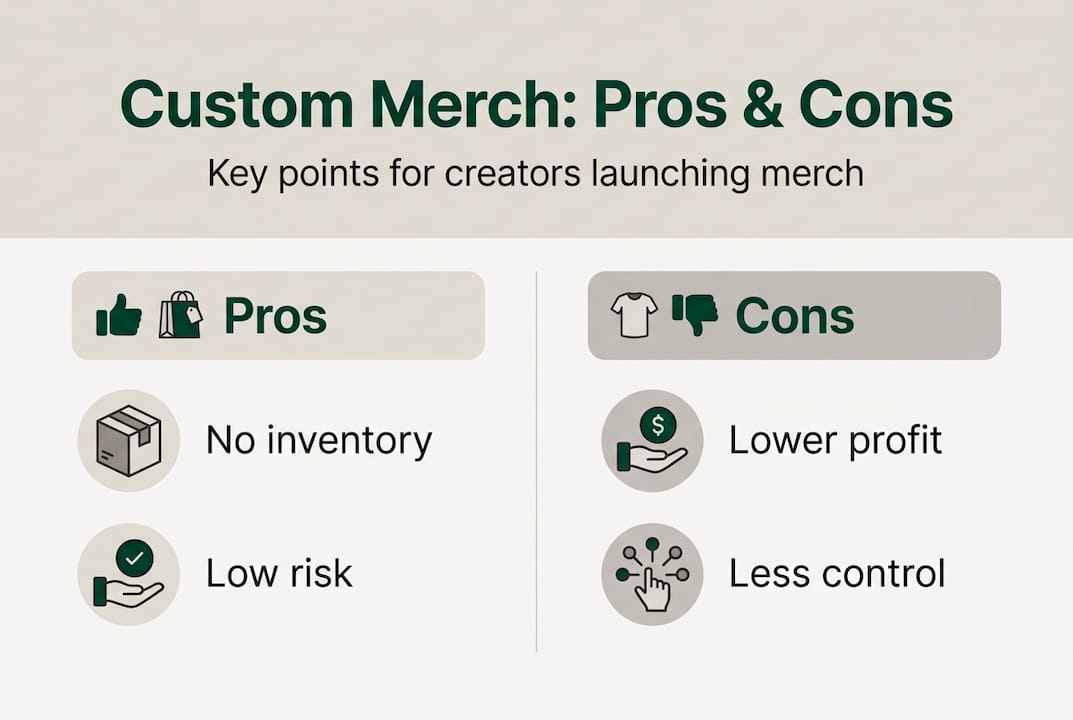
| Benefit | Challenge |
|---|---|
| No inventory or upfront stock costs | Thinner profit margins per unit |
| Low financial risk to start | Marketing is entirely your responsibility |
| Builds fan connection and brand identity | Quality can vary between print runs |
| Sustainable: only produce what sells | Shipping takes 7 to 14 days on average |
| Scalable without extra logistics | Platform dependency if using marketplaces |
The benefits are real. No inventory means no financial exposure if a design does not sell. Fans who buy your merch become walking advocates for your work. The sustainability angle is genuine too: on-demand production eliminates the overstock problem that plagues traditional merchandise models.
But the challenges deserve equal attention. POD is not passive: thin margins mean you need volume, and volume requires consistent marketing. Quality inconsistency is a real risk, which is why ordering samples before launch is non-negotiable. Shipping delays of 7 to 14 days are standard, and customs can extend that further for international orders. Design theft is also a genuine concern on open marketplaces.
The key risks to watch for include:
- Quality inconsistency — always test before selling
- Shipping delays — set clear expectations with your audience
- Design theft — watermark previews and monitor listings
- Platform dependency — marketplaces can change rules or fees without warning
Pro Tip: Focus on personal brand merch ideas that are specific to your creative identity. Generic designs compete with thousands of other sellers. Designs that only make sense to your fans convert far better.
Choosing merch platforms: marketplaces vs your own store
Having compared the overall benefits and drawbacks, the next decision is which type of platform best fits your creative and business needs. This choice shapes everything from your profit margin to how much control you have over your brand.
Marketplaces (such as Redbubble or Merch by Amazon) offer:
- Fast setup with no technical knowledge required
- Built-in audience browsing the platform
- Lower control over pricing, branding, and customer data
- Reduced ability to build a direct relationship with buyers
Your own store (such as Shopify connected to a POD supplier) offers:
- Full control over design, pricing, and customer experience
- Direct access to buyer data for email marketing
- More work required to drive traffic
- Higher potential margins and brand consistency
As POD platform analysis makes clear, marketplaces are easy but give you less control, while your own store paired with POD gives you the strongest long-term position. For musicians and artists specifically, integrating your store with Spotify, Instagram, or TikTok dramatically increases conversion. The indie artist merch design process guide covers how to align your visual identity across platforms for maximum impact.
“The creators who build the most sustainable merch income are those who own their audience. A marketplace gives you reach. Your own store gives you a relationship.”
The distinction matters because a fan who buys from your store becomes a contact you can market to again. A fan who buys from a marketplace is essentially a stranger after the transaction.
How to succeed: expert strategies for creators
Knowing the models and pitfalls is crucial, but real success comes from experienced strategy. Here is how creators are winning with merch in 2026.
- Pick a niche and own it — band merch, artist prints, and community-specific designs outperform generic products every time
- Build your store before you build your audience — have somewhere to send people from day one
- Brand everything consistently — fonts, colours, and tone should match your music or artwork
- Order and test samples — never list a product you have not held in your hands
- Iterate based on sales data — drop what does not sell, double down on what does
- Market actively across every channel — socials, email lists, and streaming profiles all contribute
The numbers make the case clearly. Musicians with 50,000 listeners can generate over £16,000 in merch profit at a 3% fan conversion rate. That is not a fantasy figure. It is what happens when you integrate your store with Spotify and promote consistently. The 3% conversion benchmark is achievable for creators who treat merch as part of their overall brand strategy rather than an afterthought.
Deep audience connection is the real differentiator. A design that references an inside joke from your lyrics or a visual motif your fans already recognise will outsell a polished but generic graphic every time. As expert band merch guidance consistently emphasises, the creators who succeed are those who niche deeply and build genuine relationships with their audience. Merch that resonates with fan engagement and community creates repeat buyers, not one-time transactions.
Pro Tip: Do not wait until you have thousands of followers to launch merch. Start small, test two or three designs, and use early sales to fund better products. The learning you get from your first ten orders is worth more than any course.
Ready to launch your own custom merch?
If these strategies have sparked something, the next step is finding the right support to put them into practice. At The Inner Sanctum Group, we handle the entire merch process for independent artists and musicians: from design preparation and printing through to packaging, fulfilment, and online store management. You focus on your creative work. We handle the rest.
Whether you are starting from scratch or looking to improve an existing setup, our merch store setup guide is a practical starting point. We work with creators at every stage, from first design to scaling a full product range, with no upfront stock costs and no complicated logistics to manage on your end. Get in touch to find out how we can build something that genuinely represents your brand.
Frequently asked questions
Is custom merchandise profitable for small creators?
Yes, profit is achievable with a dedicated fanbase and smart marketing. Musicians at 3% conversion with 50,000 listeners can generate over £16,000 in merch income, though margins vary by platform and product.
How long does it take for fans to receive custom merch?
Most orders arrive within 7 to 14 days, though international shipping and customs can extend that timeline depending on the destination and supplier.
Do I need my own website to sell custom merchandise?
No, you can begin on marketplaces immediately, but owning your store gives you far greater control over branding, pricing, and the direct relationship you build with your buyers.
What products are best for beginner creators?
T-shirts, mugs, posters, and tote bags are the strongest starting points because they are straightforward to design and appeal broadly to fans across most creative niches.
Recommended
- The merch process explained for independent creators 2026 – The Inner Sanctum Group
- What is creator merch management? A 2026 guide for artists – The Inner Sanctum Group
- What is merch production: a guide for indie creators – The Inner Sanctum Group
- Merch store setup guide for independent artists 2026 – The Inner Sanctum Group
- What is gothic merchandise? Your guide to dark fashion – GothMarket