
How merch boosts student engagement and community spirit
Most student organisations treat merchandise as a fundraising afterthought. You sell a few hoodies at freshers’ fair, cover some printing costs, and move on. But that framing misses something significant. Merch is one of the most powerful tools a student society has for building identity, attracting new members, and creating the kind of buzz that keeps people coming back. This guide breaks down why merch matters, how to use it strategically, and exactly how to launch a campaign that works for your group.
Table of Contents
- Why merch matters for student engagement
- Merch as a tool for visibility and recruitment
- FOMO, exclusivity and event-tied merch: driving real action
- Merch as a revenue engine: margin, risk management, and success stories
- Practical steps: launching successful merch for your student group
- Level up your student merch with customisable gear
- Frequently asked questions
Key Takeaways
| Point | Details |
|---|---|
| Merch builds community | Branded items signal identity, boosting pride and student engagement. |
| Visibility drives recruitment | High-quality merch turns members into walking ads and attracts newcomers. |
| FOMO boosts participation | Limited-edition and event merch create urgency and social buzz around activities. |
| Smart sales maximise profit | Pre-orders and print-on-demand keep margins high while limiting financial risk. |
| Actionable merch strategy | A clear plan makes launching engaging merch easy and impactful for your group. |
Why merch matters for student engagement
Merch does something that a poster on a noticeboard simply cannot. It turns your members into walking representatives of your community. When someone wears your society’s hoodie to a lecture, they are signalling belonging, and that signal is visible to every potential member who walks past.
There is also a social proof element at work. Seeing peers wear branded items makes a group look active, established, and worth joining. Merch sales and promotions increase visibility and attract new members through social proof and the urgency created by limited-edition items. That urgency is real. When students know a design is only available for a short window, they act faster.
Exclusive and limited items also create FOMO, which is the fear of missing out. A run of 50 event-specific tote bags sells out in hours precisely because scarcity makes people value things more. Event-specific merch goes further still, giving attendees a reason to share photos online and tag your society, which extends your reach well beyond the room.
Here is what well-executed merch can do for your student organisation:
- Build a recognisable group identity that persists beyond committee changes
- Signal credibility and activity to prospective members
- Create urgency around events and campaigns through limited releases
- Generate organic social media content when members share photos
- Put your society on the campus map in a way that digital posts rarely achieve
“The most successful student communities are not just organised, they are visible. Merch is one of the fastest ways to make that visibility tangible and lasting.”
If you are looking for inspiration on what to create, exploring creative merch ideas can help you think beyond the standard printed t-shirt. And if you want to understand the broader case for why merch supports brand and revenue, the principles apply just as well to student groups as they do to independent artists.
Merch as a tool for visibility and recruitment
Quality is not optional. A flimsy t-shirt gets worn once and forgotten. A well-made hoodie becomes part of someone’s weekly rotation, generating impressions every single time it is worn. Practical, high-quality items like t-shirts, hoodies, tote bags, and accessories ensure repeated use, turning wearers into walking advertisements that boost event attendance and organisation recognition.
The items you choose matter enormously. Below is a breakdown of popular student merch options and what each one does well.
| Item | Best use | Visibility level | Typical lifespan |
|---|---|---|---|
| Hoodie | Everyday wear, cold weather | Very high | 2 to 4 years |
| T-shirt | Events, casual wear | High | 1 to 3 years |
| Tote bag | Campus use, commuting | High | 2 to 5 years |
| Mug | Home and study use | Medium | 3 to 5 years |
| Keyring | Daily carry item | Low to medium | 1 to 3 years |
| Coaster | Shared spaces, common rooms | Low | 2 to 4 years |
Wearable items consistently outperform desk items for recruitment purposes. A student carrying your tote bag through the library is a passive advertisement to dozens of people. That same student posting a photo at your event extends that reach to their entire social network.
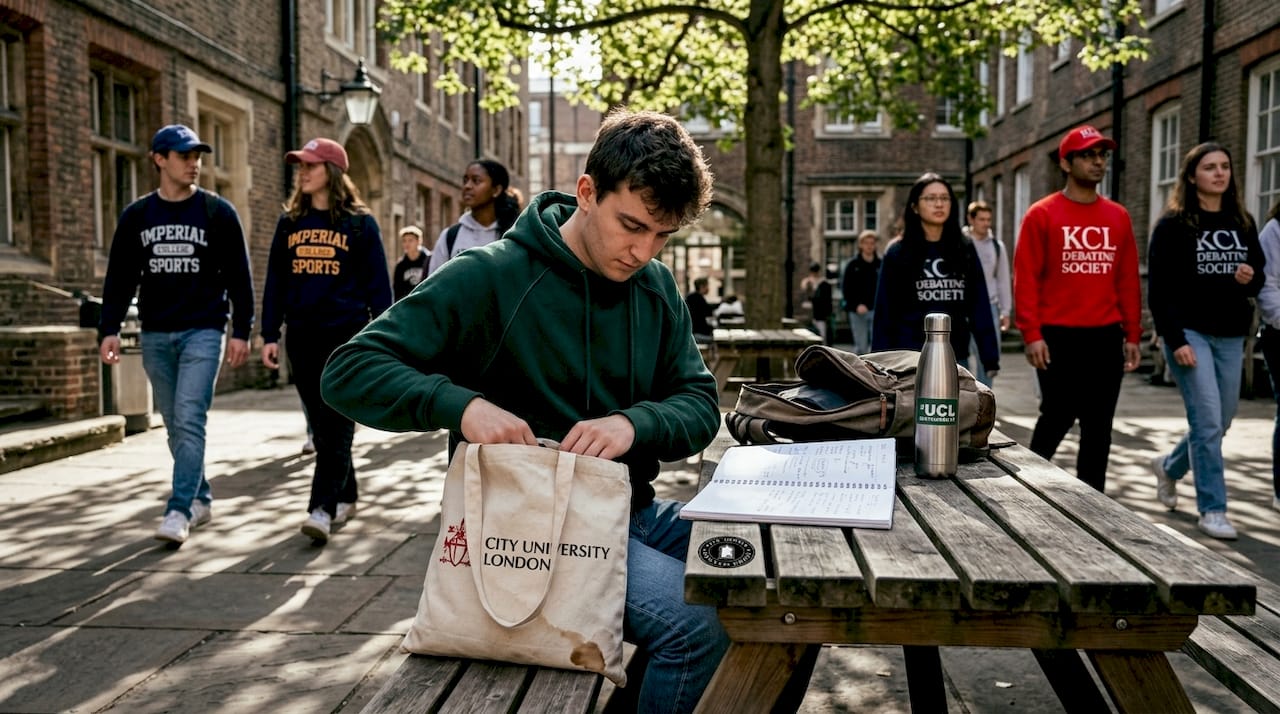
At events, merch amplifies your presence in a way that banners and flyers cannot replicate. When attendees wear or carry your branded items, every photo taken at the event becomes promotional content. That content lives on social media long after the event ends, continuing to attract interest.
Pro Tip: Avoid ordering low-quality or overly niche items just because they are cheap. A well-designed, practical item worn repeatedly is worth ten times more than a novelty product that ends up in a drawer. Check out school store best practices for guidance on choosing items that actually get used.
For a full walkthrough of how to get your online store set up, the merch store setup guide covers the process clearly. And if you want to get the visual side right from the start, the design process for student merch is a useful starting point.
FOMO, exclusivity and event-tied merch: driving real action
Standard merch sits in a shop and waits. Event-tied and limited-edition merch creates a reason to act now. That distinction is the difference between a passive fundraising tool and an active engagement driver.
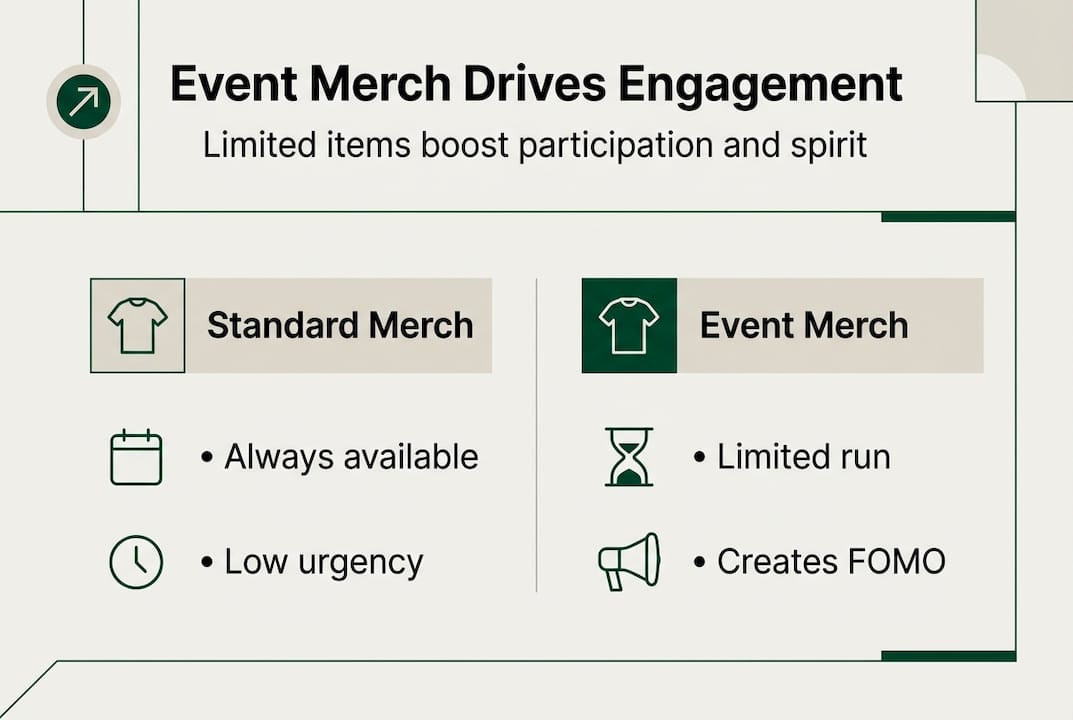
Limited-edition and event-tied merch leverages FOMO to drive participation, with real examples showing measurable increases in event attendance and social media activity. The psychology is straightforward. When something is scarce and time-limited, it becomes desirable in a way that unlimited stock never can be.
Here is how a standard merch launch compares to a limited, event-tied one:
| Factor | Standard launch | Limited or event-tied launch |
|---|---|---|
| Urgency | Low | High |
| Social media sharing | Occasional | Frequent |
| Event attendance impact | Minimal | Significant |
| Perceived value | Standard | Elevated |
| Sell-through rate | Variable | Near 100% |
The numbers speak for themselves. A limited run almost always sells out, while open-ended stock can sit unsold for months. The limited edition promo benefits are well documented, and student organisations are in a uniquely strong position to use this tactic because their audiences are tight-knit and highly responsive.
Here is a simple process for planning an event-tied merch drop:
- Choose the event and decide what makes it worth commemorating with exclusive merch.
- Set a production limit based on expected attendance, keeping it slightly below demand to maintain scarcity.
- Announce the drop in advance across your society’s social channels to build anticipation.
- Offer pre-orders to gauge interest and reduce financial risk before committing to a print run.
- Release at the event or just before it, and encourage members to share photos online with a specific hashtag.
- Follow up with a post-event recap that features the merch prominently, extending the buzz.
For more on how merch supports the broader identity of a group, the guide on merch supports group branding is worth reading alongside this section.
Merch as a revenue engine: margin, risk management, and success stories
Let us talk numbers. Merch is not just a community tool. It is a genuine revenue stream when managed well. Profit margins from merch sales range between 40 and 70 percent, with pre-orders and print-on-demand models significantly reducing financial risk. That margin can fund events, subsidise membership costs, or cover operational expenses that would otherwise strain your committee.
Here is a breakdown of how those margins typically work in practice:
- T-shirts and hoodies tend to carry the highest margins due to volume and relatively low production costs
- Accessories like tote bags and keyrings offer strong margins but lower average sale prices
- Limited runs command premium pricing, which pushes margins toward the higher end
- Pre-orders eliminate the risk of unsold stock entirely, making them the safest approach for new groups
- Print-on-demand means you only produce what is sold, removing upfront investment altogether
Imperial College London’s student union is a strong example of what is possible. By restructuring their retail approach and focusing on quality, relevant products, they achieved meaningful revenue growth that directly supported student activities. That kind of transformation is not reserved for large institutions. Any society with a clear identity and a willing audience can replicate the principle.
“The shift from selling merch as an afterthought to treating it as a structured revenue stream changed everything for our retail operation.”
Pro Tip: Use pre-order data to forecast demand before committing to a full print run. Even a simple Google Form asking members which items they would buy tells you far more than guessing. This approach, combined with merch business models built around print-on-demand, keeps your finances clean and your committee stress-free. For further reading on school store margin strategies, there are practical benchmarks worth reviewing.
Practical steps: launching successful merch for your student group
Knowing the theory is one thing. Having a clear plan is another. Here is a step-by-step framework for getting your student merch off the ground without the usual headaches.
- Define your identity first. What does your society stand for? Your merch design should reflect that clearly, not just feature a logo on a plain shirt.
- Choose your products wisely. Prioritise wearable, practical items that your members will actually use. Refer back to the table in the visibility section for guidance.
- Set a realistic budget. Decide whether you are using pre-orders, print-on-demand, or a small upfront run. Pre-orders are the lowest-risk starting point.
- Design with purpose. Keep designs clean, bold, and relevant to your audience. Overly complex artwork rarely translates well onto fabric.
- Build anticipation before launch. Tease the designs on social media, involve members in voting on options, and create a sense of event around the release.
- Sell at the right moments. Freshers’ fair, society events, and the start of term are your highest-traffic opportunities.
- Track what sells. Record which items move fastest so you can make smarter decisions next time.
Common pitfalls to avoid:
- Ordering too much stock upfront without testing demand first
- Choosing items based on price alone rather than quality and practicality
- Launching without any promotion or build-up
- Ignoring feedback from members about what they actually want to wear
- Forgetting to photograph and share the merch on social media after launch
Merch sales and promotions generate revenue for student organisations while increasing visibility and attracting new members. The key is treating the process as a proper campaign rather than a one-off order. For more on developing your brand through merch, there is plenty of practical guidance to build on.
Level up your student merch with customisable gear
You now have the strategy. The next step is finding a production partner that makes the process genuinely straightforward. The Inner Sanctum Group handles everything from design preparation through to printing, packaging, and shipping, so your committee can focus on running the society rather than managing logistics.
Whether you are starting with a small run of ISG customisable t-shirts or adding custom student tote bags to your next event, the process is designed to be simple and risk-free. There is no need to buy stock upfront. You upload your design, set your products live, and ISG takes care of the rest. Ready to get started? Launch your student merch and see how straightforward it can be.
Frequently asked questions
What types of merch work best for student engagement?
Wearable items like t-shirts, hoodies, and tote bags maximise visibility because they are used repeatedly in public spaces, turning members into everyday ambassadors for your society.
How can merch help recruit new members?
Visible, well-designed merch signals that a society is active and worth joining. Social proof and FOMO from limited items make prospective members more likely to seek out your group and get involved.
How much profit can student organisations expect from selling merch?
Profit margins range between 40 and 70 percent, particularly when using pre-orders or print-on-demand to avoid excess stock and upfront costs.
What is the easiest way to manage merch stock and reduce risk?
Pre-orders and print-on-demand models mean you only produce what has already been sold, eliminating the risk of unsold inventory and keeping your finances predictable.
Recommended
- Boost your personal brand with creative merch ideas in 2026 – The Inner Sanctum Group
- How merch supports team branding for indie musicians – The Inner Sanctum Group
- How merch supports independent artists’ brand and revenue – The Inner Sanctum Group
- Merchandising for independent musicians: create and sell fan favourite – The Inner Sanctum Group
- 7 benefici delle community di studenti per il diploma online - Recupero Anni Scolastici e Diploma Online