
What is artist e-commerce and how to sell merch online
You don’t need thousands in upfront capital to launch a successful merch business. Artist e-commerce platforms have transformed how independent creators monetise their work, eliminating inventory risk entirely. This comprehensive guide walks you through understanding print-on-demand models, setting up your store, designing compelling products, and promoting effectively to your fanbase. Whether you’re a musician, visual artist, or content creator, you’ll discover practical strategies to generate revenue from merchandise without buying stock upfront.
Table of Contents
- Key takeaways
- Understanding artist e-commerce and print-on-demand models
- Benefits of artist e-commerce for independent creators
- Step-by-step guide to launching your artist e-commerce store
- Design and promotion strategies for artist merch success
- Explore artist merch options with The Inner Sanctum Group
- Frequently asked questions about artist e-commerce
Key Takeaways
| Point | Details |
|---|---|
| No upfront inventory | Print on demand lets you sell without buying stock first, reducing financial risk. |
| Direct to fan | Artists control data and pricing while engaging supporters, strengthening relationships. |
| Risk free design testing | You can test multiple designs without financial commitment and scale what sells. |
| Fulfilment handled by provider | The print on demand partner manages production quality, packing, shipping and returns, freeing you to focus on creating. |
Understanding artist e-commerce and print-on-demand models
Artist e-commerce refers to online platforms and models enabling independent artists, musicians, and content creators to sell merchandise, digital products, music, and art directly to fans without upfront inventory costs, primarily via print-on-demand fulfilment. This approach fundamentally differs from traditional retail, where you’d purchase bulk inventory before making a single sale.
The print-on-demand workflow operates through a straightforward sequence. You upload your design to a platform, create product listings in your online merch store, and set your prices. When a fan places an order, the print-on-demand provider receives the request automatically. They print your design onto the selected product, package it, and ship directly to your customer. You never touch inventory, manage warehousing, or handle shipping logistics.
This model removes the most significant barrier facing independent creators: financial risk. Traditional merchandising required purchasing minimum order quantities, often 50 to 100 units per design. If a design didn’t resonate with your audience, you’d be stuck with unsold inventory and wasted capital. Print-on-demand eliminates this gamble entirely.
Common merchandise types available through artist e-commerce platforms include:
- Apparel such as t-shirts, hoodies, and tank tops
- Accessories including tote bags, phone cases, and hats
- Home goods like posters, prints, mugs, and coasters
- Stationery items such as notebooks, stickers, and greeting cards
- Digital downloads including music files, artwork prints, and exclusive content
The beauty of this system lies in its scalability. You can offer dozens of product variations without any additional investment. Testing new designs becomes risk-free experimentation rather than financial commitment. Your catalogue can grow organically based on what your audience actually purchases, not what you guessed they might want.
Benefits of artist e-commerce for independent creators
Print-on-demand allows independent artists to sell custom merchandise without the risk and cost of upfront inventory or shipping management. This fundamental shift in the merchandising model creates opportunities that were previously accessible only to artists with significant capital or corporate backing.
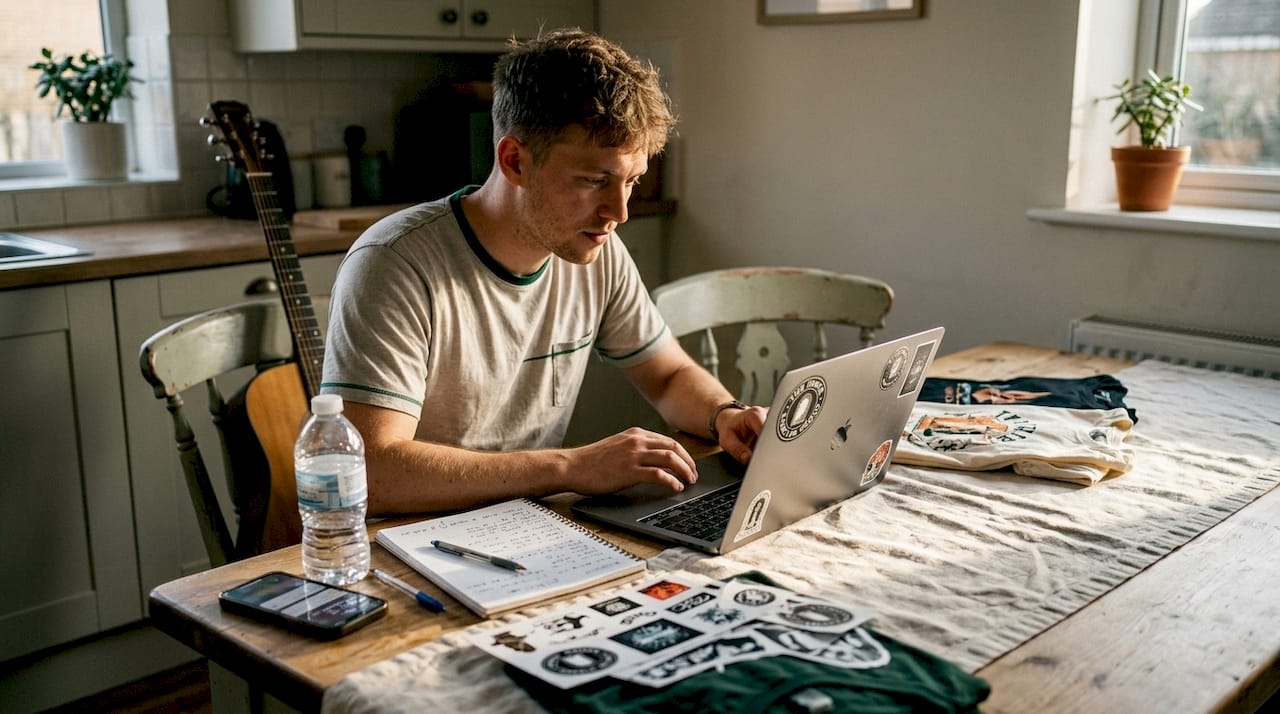
The financial advantages extend beyond eliminating upfront costs. You pay production costs only after receiving payment from customers, meaning you’re never out of pocket. Profit margins remain under your control through pricing decisions. There’s no risk of overproduction, no storage fees eating into profits, and no need to discount unsold stock.
Direct fan relationships strengthen considerably when you control your e-commerce presence. You capture customer data, understand purchasing patterns, and communicate directly without intermediaries. This connection allows you to create exclusive products for your most engaged supporters, building community around your brand. Fans appreciate supporting artists directly rather than through third-party retailers.
Operational simplicity represents another major benefit. The print-on-demand provider handles:
- Product manufacturing and quality control
- Order fulfilment and packaging
- Shipping logistics and tracking
- Returns and exchange processing
- Customer service for delivery issues
This arrangement frees you to focus on creative work and audience building rather than logistics management. You’re running a merchandise business without actually running the operational side of a merchandise business.
Testing and iteration become effortless when there’s no inventory commitment. Launch a new design today, gauge response over a week, and discontinue it if sales disappoint. No financial loss, no wasted resources. Successful designs can remain available indefinitely, generating passive income long after you’ve moved on to new creative projects.
Pro Tip: Focus on unique design storytelling that reflects your artistic journey and resonates emotionally with your audience. Generic designs rarely convert as well as merchandise that feels authentically connected to your creative identity. Fans buy merch to support you specifically, so give them designs that celebrate that relationship.
The scalability factor cannot be overstated. As your audience grows, your merch operation supports your brand and revenue without requiring proportional increases in your time investment. A thousand orders require the same effort from you as ten orders. This scalability makes artist e-commerce genuinely passive income once your store is established.
Step-by-step guide to launching your artist e-commerce store
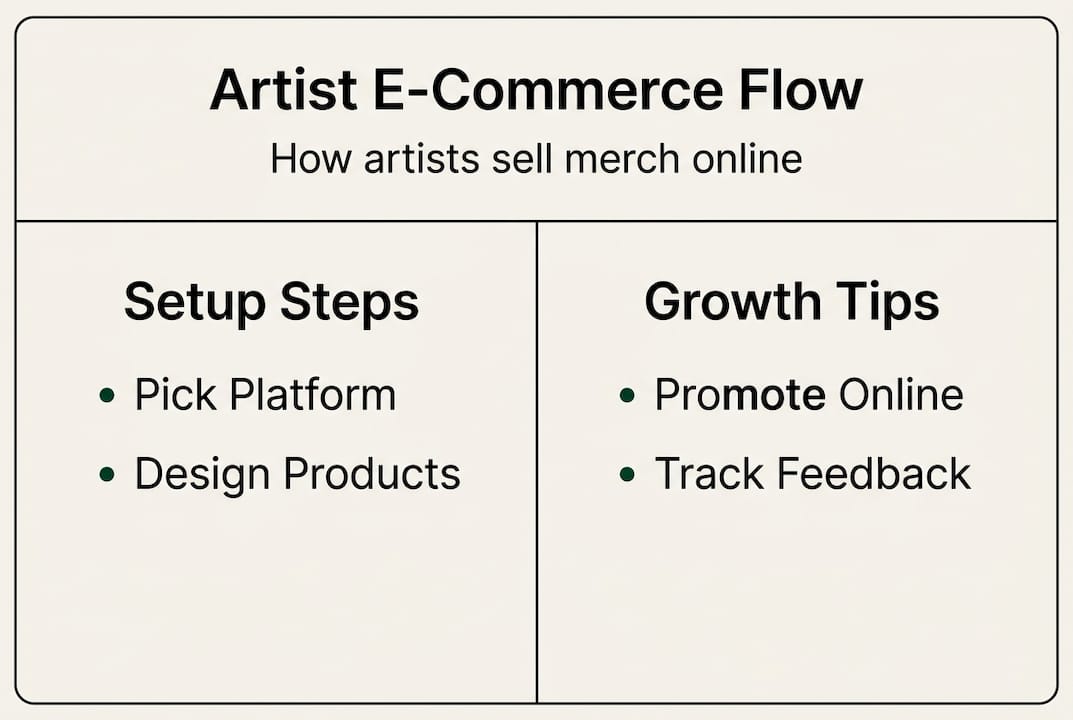
Launching your artist e-commerce store requires methodical planning and execution across several key phases. This practical walkthrough covers everything from platform selection to your first sales.
1. Research and select your print-on-demand platform
Evaluate platforms based on product range, printing quality, shipping speeds, geographic coverage, integration options, and pricing structure. Request sample products to assess quality firsthand. Consider whether you want a standalone store or integration with existing websites and social media shops.
2. Develop your merchandise designs
Create original artwork that reflects your artistic identity and appeals to your specific audience. If design isn’t your strength, commission work from graphic designers who understand your vision. Ensure designs work technically for printing by following each platform’s file specifications for resolution, colour modes, and safe zones.
3. Configure your online store
Set up your merch store with compelling product listings that include high-quality mockup images, detailed descriptions, size guides, and care instructions. Write product descriptions that tell the story behind each design rather than simply describing what customers can see. Set competitive pricing that covers production costs, platform fees, and leaves you with meaningful profit margins.
4. Implement your promotional strategy
Launch your store with coordinated promotion across your social channels, email list, and website. Create announcement content that builds excitement rather than simply stating products are available. Consider offering launch discounts or limited-edition items to drive initial momentum.
5. Monitor performance and gather feedback
Artists typically upload designs, list products on their store, and rely on print-on-demand providers to print and ship only after orders are placed. Track which products sell, which marketing channels drive traffic, and what feedback customers provide. Use this data to refine your catalogue and promotional approach continuously.
| Platform feature | Printful | Printify | Redbubble | Teespring |
|---|---|---|---|---|
| Product range | 300+ items | 800+ items | 70+ items | 50+ items |
| Base costs | Higher | Lower | Set margin | Set margin |
| Store integration | Excellent | Excellent | Built-in | Built-in |
| Shipping speed | 2-7 days | 2-10 days | 5-14 days | 3-10 days |
| Design ownership | Full | Full | Shared | Full |
| Best for | Quality focus | Budget conscious | Passive income | Simplicity |
Pro Tip: Use high-quality mockups and maintain consistent branding across all product images to establish professionalism and build trust with potential customers. Inconsistent or low-quality visuals signal amateurism, while polished presentation suggests reliability and quality.
Your indie artist merch design process should evolve based on sales data and customer feedback. The most successful artist stores treat merchandise as an extension of their creative practice, not a separate commercial venture. Authenticity resonates far more powerfully than designs created purely for commercial appeal.
Design and promotion strategies for artist merch success
Creative and distinctive merch designs combined with targeted promotion increase artist merch sales and fan engagement. Your design approach and promotional tactics directly determine whether your e-commerce venture generates meaningful revenue or languishes with occasional sympathy purchases.
Effective merch design starts with understanding what your audience values about your work. Survey your most engaged fans about what designs would excite them. Study which of your existing content generates the strongest reactions. Look for visual motifs, phrases, or concepts that define your creative identity. The goal is creating merchandise that fans genuinely want to own and display, not generic products with your logo slapped on.
Design principles for artist merchandise include:
- Distinctive visual style that’s immediately recognisable as yours
- Designs that work aesthetically as standalone pieces, not just fan signalling
- Appropriate complexity for the printing method and product type
- Colour palettes that reproduce well across different materials
- Typography that remains legible at various sizes
Promotion requires strategic thinking about where your audience spends time and what motivates their purchasing decisions. Social media remains crucial, but effectiveness varies dramatically by platform and approach. Email marketing often outperforms social for direct sales because subscribers have already indicated interest. Live events and performances create ideal merchandising moments when emotional connection peaks.
| Platform | Reach potential | Cost efficiency | Engagement rate | Best content type | Ideal frequency |
|---|---|---|---|---|---|
| High | Medium | 1-3% | Visual showcases | Daily stories, 3-5 posts/week | |
| TikTok | Very high | High | 5-10% | Behind-the-scenes | 3-7 videos/week |
| Medium | Low | 0.5-1% | Community building | 2-3 posts/week | |
| Medium | Medium | 0.5-2% | Announcements | Multiple daily | |
| Targeted | Very high | 15-25% | Exclusive offers | Weekly to monthly | |
| YouTube | High | Medium | 3-5% | Process videos | Weekly |
Engagement-driven campaigns generate significantly better results than simple product announcements. Giveaways build excitement and expand reach through sharing mechanics. Limited edition releases create urgency and reward your most attentive fans. Involving your audience in design decisions through polls or voting makes them invested in the final products. Collaborative designs with other artists introduce your merch to new audiences.
Pro Tip: Timing promotions around new releases, tour announcements, or significant milestones maximises attention when your audience is already engaged with your work. A new album release is the perfect moment to launch related merchandise, not three months later when momentum has faded.
Your creative merch ideas should extend your artistic vision rather than feeling like commercial compromise. The most successful artist merchandise creates additional value for fans beyond the music, art, or content itself. Think of merch as wearable or usable art that strengthens the relationship between you and your supporters.
Consider how merch supports team branding for indie musicians by creating visual identity and community belonging. These same principles apply across all creative fields. Merchandise transforms passive audience members into active participants who display their support publicly.
Explore artist merch options with The Inner Sanctum Group
The Inner Sanctum Group offers independent creators a comprehensive print-on-demand solution designed specifically for artists and musicians. Our platform handles the entire merchandising process, from design preparation through fulfilment, letting you focus on creative work while we manage logistics.
Our customisable product range includes premium apparel options like the ISG Creator 2.0 T-Shirt featuring 180 GSM fabric quality, the Output Logo T-Shirt with distinctive branding options, and the ISG E220 oversized T-Shirt offering 220 GSM premium weight construction. Each product is ready for your custom designs, with no minimum orders and commission-based earnings on every sale. We print, pack, and ship directly to your fans while you earn revenue without upfront investment.
Frequently asked questions about artist e-commerce
How does selling merch with no upfront payment actually work?
Print-on-demand platforms manufacture products only after customers place and pay for orders. You set retail prices above production costs, and the platform deducts manufacturing and shipping fees from each sale before paying you the difference. You never purchase inventory or pay before receiving customer payments.
What technical skills do I need to set up an artist e-commerce store?
Most platforms require only basic computer skills like uploading images, writing product descriptions, and copying links. No coding or web development knowledge is necessary. If you can use social media and email, you can manage an artist e-commerce store. Many platforms offer setup tutorials and customer support.
What legal considerations apply when selling merch internationally?
You’re responsible for collecting and remitting applicable taxes based on where you and your customers are located. Most print-on-demand platforms handle customs documentation for international shipments. Ensure your designs don’t infringe copyrights or trademarks. Consider basic business registration and liability insurance as your revenue grows. Consult local regulations regarding self-employment income reporting.
How do I handle customer service with print-on-demand providers?
Most platforms manage shipping issues, damaged products, and returns directly with customers. You typically handle questions about designs, sizing guidance, and general enquiries. Clear communication about production times and shipping expectations in product descriptions prevents most problems. Review your platform’s customer service policies to understand what they handle versus what remains your responsibility. For comprehensive guidance on managing these aspects, explore creator merch management best practices.
Can I use artist e-commerce alongside other revenue streams?
Absolutely. Artist e-commerce complements rather than replaces other income sources like performances, commissions, licensing, crowdfunding, or content monetisation. Many creators find merchandise provides more stable income than project-based work. The passive nature of print-on-demand means your store generates revenue even when you’re focused entirely on other activities.
How long does it take to see meaningful sales from artist merch?
Timelines vary based on your existing audience size and engagement levels. Creators with established followings often see immediate sales, while those building audiences may need several months of consistent promotion. Focus on growing your fanbase and creating compelling designs rather than expecting overnight success. Most successful artist stores report meaningful revenue after three to six months of active promotion and catalogue development.
Recommended
- What is an online merch store? A guide for artists in 2026 – The Inner Sanctum Group
- Merch store setup guide for independent artists 2026 – The Inner Sanctum Group
- How merch supports independent artists’ brand and revenue – The Inner Sanctum Group
- What is creator merch management? A 2026 guide for artists – The Inner Sanctum Group
- How NFT Rappers Are Revolutionizing the Music Industry – Stevie The Manager aka Stangr The Man