
How custom charity merch boosts fundraising engagement
Fundraising does not have to mean gala dinners, sponsored runs, or cold-calling major donors. Custom-branded merchandise offers charities a quieter, more consistent route to both income and visibility. Every hoodie worn at a school run, every tote bag carried through a supermarket, every mug sitting on an office desk is doing quiet promotional work on your behalf. Custom merchandise serves as an effective fundraising tool by generating revenue through sales while turning supporters into walking billboards for awareness. This guide walks you through the evidence, the models, and the practical steps to make it work for your charity.
Table of Contents
- Why custom merch matters for charities
- Fundraising mechanics: How custom merch generates income
- Awareness and perception: Turning supporters into ambassadors
- Comparing custom vs pre-made merch: Pros, cons, and context
- Sustainability and value alignment: Adding meaning to every item
- Seven practical tips for charity merch success
- Ready to take your charity’s merch to the next level?
- Frequently asked questions
Key Takeaways
| Point | Details |
|---|---|
| Branded merch drives awareness | Supporters displaying charity items raise ongoing visibility for your cause. |
| Revenue with low risk | Print-on-demand and pre-sale models allow fundraising without large up-front costs. |
| Supporter engagement grows | Quality, aligned merch creates lasting connections and increases donation likelihood. |
| Sustainability builds trust | Eco-friendly merch reflects charity values and stands out in the donor’s mind. |
| Practical steps matter | Smart design, storytelling, and integrated campaigns maximise merch impact for charities. |
Why custom merch matters for charities
Custom merchandise does something that a one-off fundraising event simply cannot: it keeps working long after the day is over. A supporter wearing your charity’s t-shirt at the gym, on the school run, or at a festival is spreading your message without any additional effort or cost from you. That kind of passive, ongoing exposure is genuinely hard to replicate through traditional campaigns.
The numbers back this up. Branded items are kept by 85% of recipients and have an average lifespan of 14 months. That is over a year of repeated impressions from a single item. And when it comes to t-shirts specifically, each one generates around 3,400 impressions over its lifespan. No social media post achieves that kind of sustained reach.
“Physical merchandise creates touchpoints with your supporters that digital campaigns rarely match. It is tangible, personal, and lasting.”
Here is what makes custom merch particularly powerful for charities:
- Passive awareness: Supporters spread your message simply by going about their daily lives.
- Emotional connection: A well-designed item feels like a keepsake, not a freebie.
- Repeated exposure: Unlike a single event, merch keeps your cause visible for months.
- Community signal: Wearing your charity’s colours signals belonging and shared values.
For inspiration on what kinds of items resonate, explore creative merch ideas that go beyond the standard t-shirt. You can also see how student engagement with merch translates directly to community-building, which mirrors what charities aim to achieve.
Fundraising mechanics: How custom merch generates income
Awareness is valuable, but charities also need income. The good news is that custom merch can deliver both simultaneously. The key is choosing the right sales model for your size, budget, and audience.
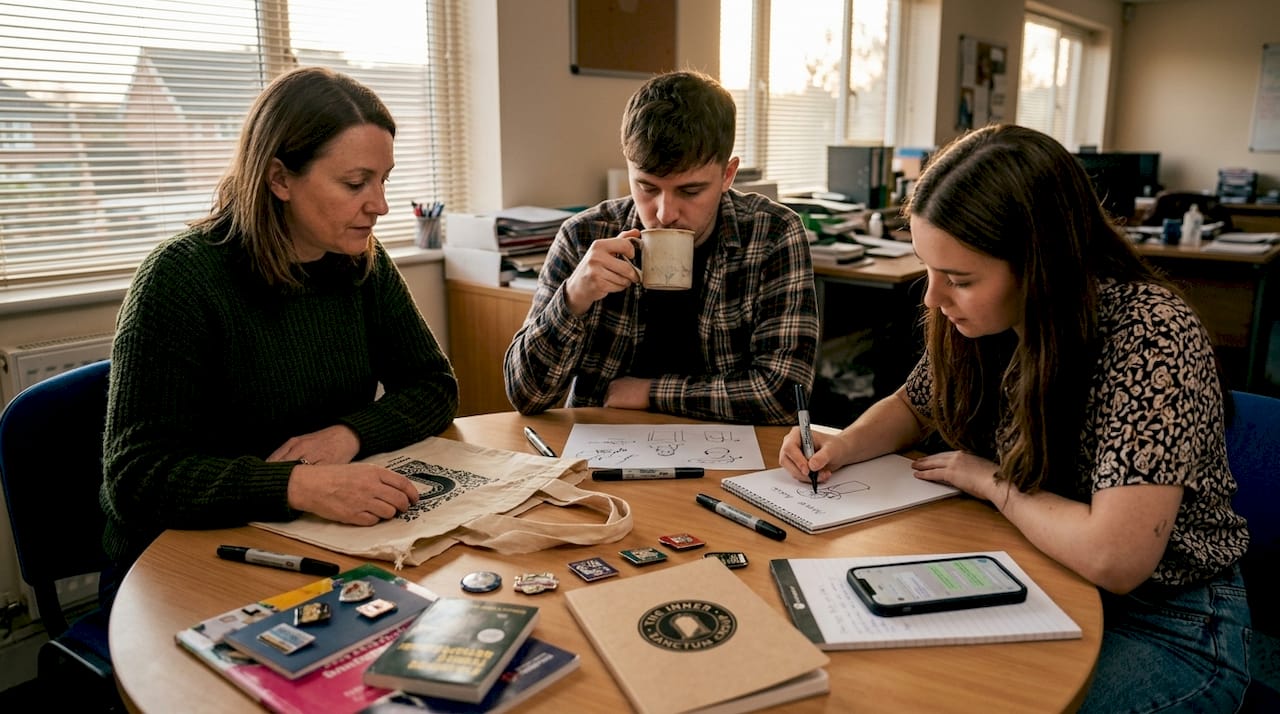
Print-on-demand and pre-sale models minimise inventory risk because no minimum orders are needed, and pre-sale avoids leftover stock entirely. Meanwhile, event-based sales drive immediate revenue, while online stores extend reach to wider supporters throughout the year.
Here is a quick comparison of the main models:
| Sales model | Upfront cost | Inventory risk | Best for |
|---|---|---|---|
| Print-on-demand | None | None | Small charities, ongoing sales |
| Pre-sale | Low | Very low | New campaigns, testing demand |
| Bulk order | Medium to high | Medium | Large events, established charities |
| Event sale | Variable | Low to medium | Fairs, runs, galas |
The numbered steps below outline how to launch a simple merch income stream:
- Choose your product: Start with one or two items that suit your audience (t-shirts and tote bags are reliable starters).
- Set your sales model: Print-on-demand or pre-sale keeps risk low for first-time campaigns.
- Price for margin: Factor in production costs and aim for a markup that reflects the cause.
- Open an online shop: A permanent store means income flows year-round, not just at events.
- Promote across channels: Email, social media, and in-person events all drive traffic to your store.
Pro Tip: Run a pre-sale round before committing to any bulk order. It validates demand, builds excitement, and means you only produce what people actually want.
If you want to understand how to sell merch online effectively, the principles used by independent musicians translate directly to charity campaigns.
Awareness and perception: Turning supporters into ambassadors
There is a meaningful difference between a supporter who donates once and one who wears your charity’s name on their chest every week. Custom merch creates the latter. It transforms passive donors into active ambassadors who carry your message into spaces you could never reach through advertising alone.
58% of recipients report a more positive perception of an organisation after receiving branded merchandise. That shift in perception matters enormously for charities, where trust is the foundation of every donation. Furthermore, higher perceived alignment between donor ideals and charity brand is directly linked with increased donations.
“When a supporter’s values and your charity’s identity feel like a match, merch becomes a symbol of that shared purpose rather than just a product.”
Here is how thoughtful merch design amplifies your charity’s reach:
- Consistent branding: Colours, logos, and slogans that reflect your mission reinforce recognition.
- Conversation starters: A striking design prompts questions, which opens doors to new supporters.
- Loyalty signals: Wearing your merch publicly is a form of public endorsement.
- Emotional resonance: Items tied to a specific campaign or cause feel more meaningful than generic products.
| Merch type | Awareness impact | Emotional value | Longevity |
|---|---|---|---|
| Custom branded t-shirt | Very high | High | 12 to 18 months |
| Generic pre-made item | Low | Low | Variable |
| Custom tote bag | High | Medium to high | 12 months or more |
| Branded mug | Medium | High | Several years |
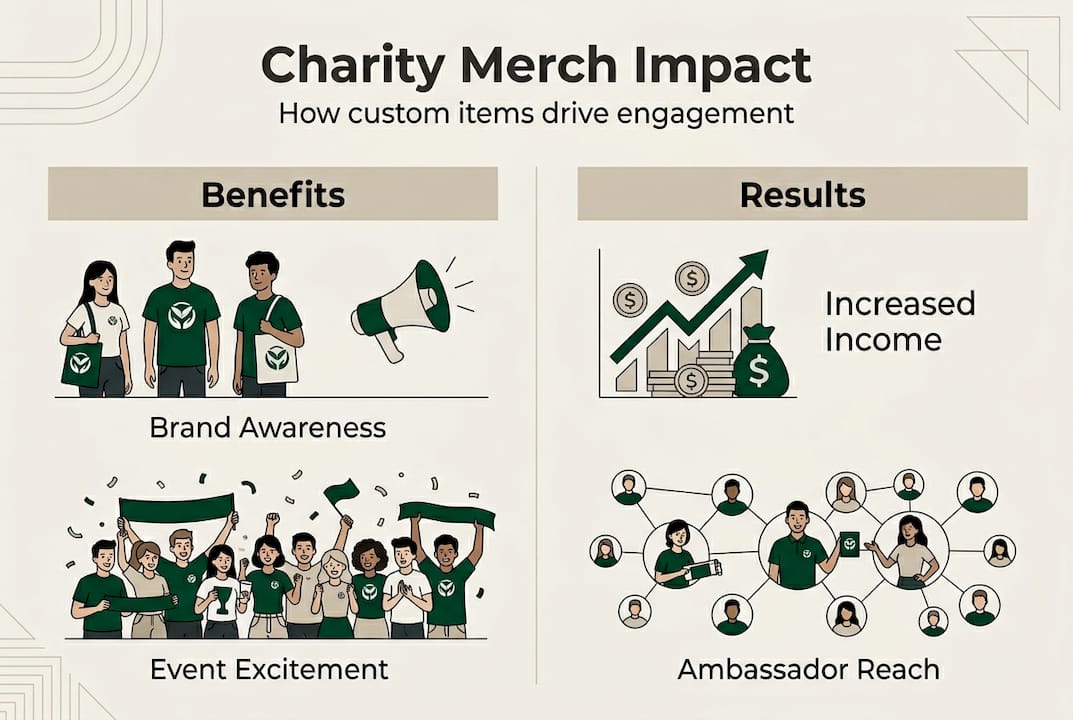
For more on how different event merch types perform across different settings, there is a useful breakdown worth reviewing before your next campaign.
Comparing custom vs pre-made merch: Pros, cons, and context
Not every charity has the budget or time for a fully custom range. Pre-made items have their place, particularly when speed or cost is the priority. But the differences in impact are significant.
Custom options excel at events and branding but carry higher upfront costs compared to pre-made alternatives. Small charities can use print-on-demand to reduce that risk considerably.
| Factor | Custom merch | Pre-made merch |
|---|---|---|
| Brand alignment | Excellent | Poor to moderate |
| Upfront cost | Low to medium (print-on-demand) | Low |
| Perceived value | High | Low |
| Supporter engagement | Strong | Weak |
| Flexibility | High | Limited |
Pro Tip: Use pre-made items for urgent, low-budget needs such as a last-minute collection tin giveaway. Reserve custom merch for flagship campaigns where brand impact and supporter loyalty matter most.
A hybrid approach works well for many charities. Pre-made items fill gaps quickly, while custom pieces anchor your major appeals and events. With print-on-demand now widely available, even the smallest charity can access custom quality without financial risk. For design guidance that applies across sectors, the fitness merch design tips article offers transferable principles on colour, typography, and product selection.
Sustainability and value alignment: Adding meaning to every item
For charities working in environmental, social, or community spaces, the materials and sourcing behind your merch send a message of their own. Choosing eco-friendly fabrics and ethical suppliers signals that your organisation genuinely lives its values, not just talks about them.
The environmental case is stronger than many people realise. Promotional products have an 8x lower carbon impact per memorised impression compared to digital advertising. That makes physical merch not only more memorable but also more environmentally responsible than running paid social campaigns.
Here is what values-driven merch looks like in practice:
- Organic cotton t-shirts and hoodies that carry a lower environmental footprint.
- Recycled material tote bags that reinforce an environmental mission.
- Locally sourced or ethically produced items that support fair labour practices.
- Transparent storytelling: Tell supporters exactly where the item came from and why you chose it.
Communicating the story behind each item is just as important as the item itself. Supporters who understand the choices behind your merch feel more connected to your cause, and that connection drives retention. For a look at how branding and product storytelling work together, the restaurant merch branding guide offers a useful parallel.
Seven practical tips for charity merch success
Getting merch right is not complicated, but it does require intention. Poor design and pricing lead to underperformance even when using custom merch, so the details matter.
- Prioritise quality and usefulness. Choose items people will actually use. A quality tote bag beats a cheap pen every time.
- Involve your audience in design. Run a poll on social media or ask your most engaged supporters for input. People back what they helped create.
- Offer pre-order rounds. Build anticipation and validate demand before committing to production.
- Integrate merch into events and communications. Feature it in newsletters, on social media, and at every in-person touchpoint.
- Tell the story behind each item. Why this design? Why this material? The narrative adds value that no price tag can.
- Use online tools to monitor stock and sales. Real-time data helps you avoid over or under-ordering.
- Review campaign data and adjust. What sold well? What did not? Use that insight to improve your next round.
Pro Tip: Ask your top donors and volunteers to model the merch on social media. Authentic peer endorsement drives far more sales than polished promotional content.
For real-world examples of how merch supports a broader brand and income strategy, see how [merch supports independent artists](https://theinnersanctumgroup.co.uk/blogs/the-merch-stand/how-merch-supports-independent artists brand revenue) in building sustainable revenue streams.
Ready to take your charity’s merch to the next level?
Everything covered in this guide points to one clear conclusion: custom merchandise is one of the most cost-effective, high-impact tools available to charities of any size. It raises funds, builds awareness, deepens supporter loyalty, and aligns with your values, all at the same time.
At The Inner Sanctum Group, we handle the entire process for you. From design preparation and printing through to packaging, fulfilment, and online store management, we make it straightforward for charities to launch and run a merch campaign without upfront stock costs. Whether you are starting your first campaign or scaling an existing one, explore our custom charity merchandise solutions and see how we can support your next fundraising push. Get in touch and let us help you turn your supporters into ambassadors.
Frequently asked questions
How does custom charity merch increase fundraising?
Each sale generates direct revenue for your cause, and every item worn or used creates repeated impressions that keep your charity visible and encourage future donations.
What is the best type of merch for small charities?
Print-on-demand and pre-sale models are ideal because they require no minimum orders and eliminate the risk of unsold stock sitting in storage.
Does charity merch really improve awareness?
Absolutely. 85% keep branded items for over a year, and a single t-shirt generates around 3,400 impressions across its lifespan, spreading your charity’s name far beyond your existing supporter base.
Is sustainable merch worth the investment for charities?
Yes. Eco-friendly merch signals that your charity practises what it preaches, and promotional products carry an 8x lower carbon impact per impression than digital advertising, making it both an ethical and practical choice.
Recommended
- How merch boosts student engagement and community spirit – The Inner Sanctum Group
- Boost your personal brand with creative merch ideas in 2026 – The Inner Sanctum Group
- Fitness merch design guide 2026: create custom gear – The Inner Sanctum Group
- Boost your trade business with merch: brand and income – The Inner Sanctum Group